
Perplexity AI vs ChatGPT: which is better for research is a question worth answering precisely, because the two tools are not actually competing for the same thing. Confusing them, as one reviewer put it, is like using a dictionary to write a novel. They were built for different jobs, and the people getting the most value from both understand that distinction clearly.
Perplexity is an AI-powered search and answer engine. It searches the web in real time, reads the results, and delivers a synthesized answer with numbered inline citations pointing back to every source it used. ChatGPT is a general-purpose AI assistant. It thinks, creates, codes, analyzes, and reasons; and it can search the web when you enable that feature, but search is not its architecture or its default mode.
That fundamental difference is what this comparison is actually about. For research specifically, sourced, verifiable, current information gathered efficiently, Perplexity and ChatGPT perform very differently. This guide covers exactly how they differ, where each wins, what the free tiers give you, and who should use which tool for what type of research work.
If you have read the guides on ChatGPT vs Claude: which AI assistant is actually better in 2026, Gemini vs ChatGPT for students: which AI tool is actually more useful, new AI models in 2026: GPT-5, Claude 4, Gemini 3, best free AI tools for students, or AI tools to make money online without investment, you already understand how these tools fit into different workflows. This guide adds Perplexity to that picture with the same honest, task-focused approach.
The Core Architectural Difference That Changes Everything
Perplexity AI vs ChatGPT: Which is Better for Research? Why They Are Not the Same Type of Tool
Before comparing features, understanding the architectural difference prevents the most common mistake people make with both tools: asking Perplexity to write a creative brief and asking ChatGPT to be a reliable real-time research engine.
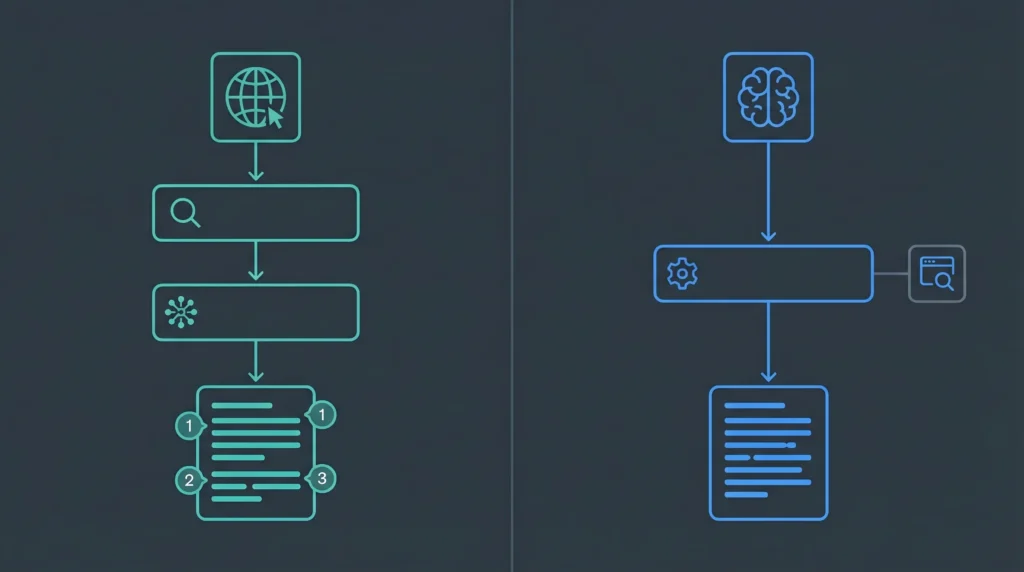
Perplexity is search-first. Its entire design is built around retrieval: finding current information on the web, reading multiple sources simultaneously, and returning a synthesized answer with the sources attached. Every answer comes with numbered citations that link directly to the original pages. The interface is designed for questions that need answers grounded in what exists on the internet right now.
ChatGPT is generation-first. Its architecture is a language model that was trained on a large corpus of text. It reasons, writes, codes, analyzes, and creates from that training. Web search in ChatGPT is a feature layered on top of a generation model; in Perplexity, web search is the foundation on which the entire product is built.
In summary: Perplexity searches and cites. ChatGPT thinks and creates. Confusing them is like using a dictionary to write a novel or a typewriter to look up a definition.
This difference explains every other comparison point that follows.
Citation Quality: The Most Practically Important Difference
Why Perplexity AI Beats ChatGPT on Citations for Research Work
For any research task where you need to verify claims before using them, citation quality is not a minor feature; it is the core issue.
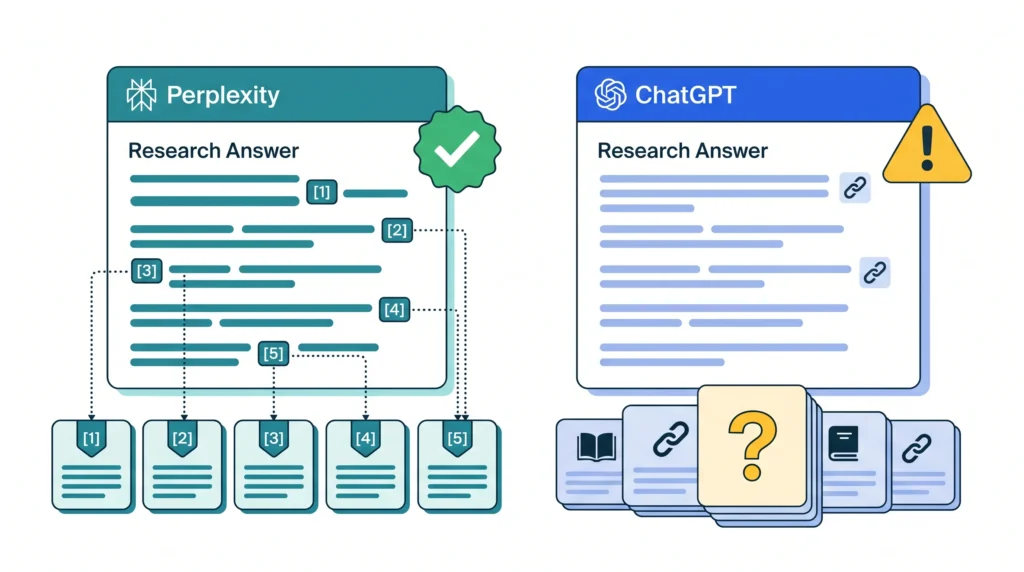
Perplexity AI provides persistent, numbered citations that link directly to original sources, making verification straightforward. ChatGPT can provide source links when real-time web search is enabled, but citations are less consistently inline and are not as central to the user interface.
The practical effect of this difference is significant. In Perplexity, every numbered claim links to the exact page where that information was found. You can click any citation and verify the original source without leaving the research session. In ChatGPT, citations appear inconsistently: sometimes included, sometimes omitted, and rarely in-line with the specific claims they support.
In a 100-query test, Perplexity’s citations were verifiable and accurate 89 percent of the time. ChatGPT’s citations, when present, were accurate 76 percent of the time, but the bigger issue is that ChatGPT often omits citations entirely, even when browsing is active, leaving users to take claims on faith.
For students writing research papers, journalists fact-checking claims, or professionals building reports that require source verification, this gap is decisive. Neither tool replaces careful verification. Both hallucinate. The difference is that Perplexity at least shows you what it thinks it is basing its answer on.
The citation hallucination rate, which measures how often cited sources do not actually support the claims they are attached to, also favors Perplexity significantly. Perplexity has the lowest citation hallucination rate among major AI search platforms at 37 percent, compared to 67 percent for ChatGPT Search. The structural caveat is that 37 percent still means more than one in three citations may be fabricated.
That last point deserves emphasis: Perplexity is the best available tool for cited AI research, and it still requires verification. It is better than ChatGPT on this dimension; it is not infallible.
Real-Time Information: Where the Gap Is Most Visible
How Perplexity and ChatGPT Handle Current Events and Recent Data Differently
For research involving recent developments, current events, newly published studies, or market data from the past few weeks, Perplexity and ChatGPT differ in a way that has direct practical consequences.
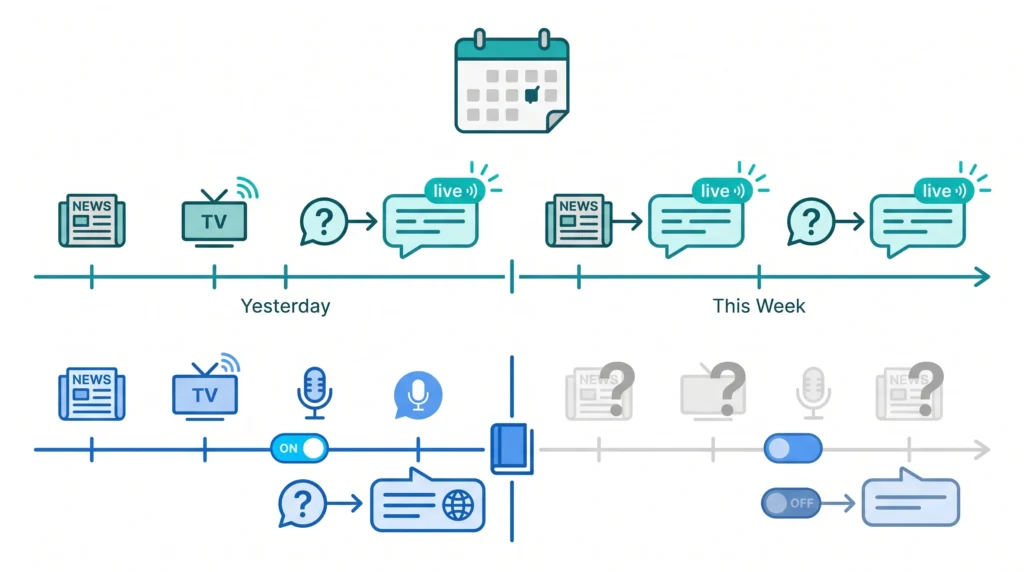
Perplexity searches the live web by default on every query. There is no toggle to enable, no setting to configure; current information is the baseline behavior. Ask about something that happened last week, and it retrieves and synthesizes what was published last week.
ChatGPT’s default behavior is to answer from its training data, which has a knowledge cutoff. Web search is available but must be explicitly used, and it does not always activate automatically on time-sensitive queries. Perplexity offers access to current information by default, including recent news, market data, and newly published research. ChatGPT relies on its model knowledge unless real-time web search is enabled, at which point it can also retrieve up-to-date information.
Perplexity is particularly useful for research on topics where new information is coming out quickly, for example, any article about AI. Its ability to synthesize what other writers have written recently on the topic and deliver nuanced answers while guiding you toward the online resources it used is very helpful. This streamlines the research process without sacrificing accuracy and depth.
For researchers tracking fast-moving fields: AI developments, medical research, financial markets, legal changes, or current events journalism, Perplexity’s default real-time behavior is a structural advantage rather than just a feature preference.
Free Tier Comparison: What Each Tool Gives You at Zero Cost
Perplexity AI Free vs ChatGPT Free: The Honest Assessment for Researchers
Both tools have genuinely useful free tiers, but they differ in what those free tiers include and where they hit their limits.
Perplexity Free Tier:
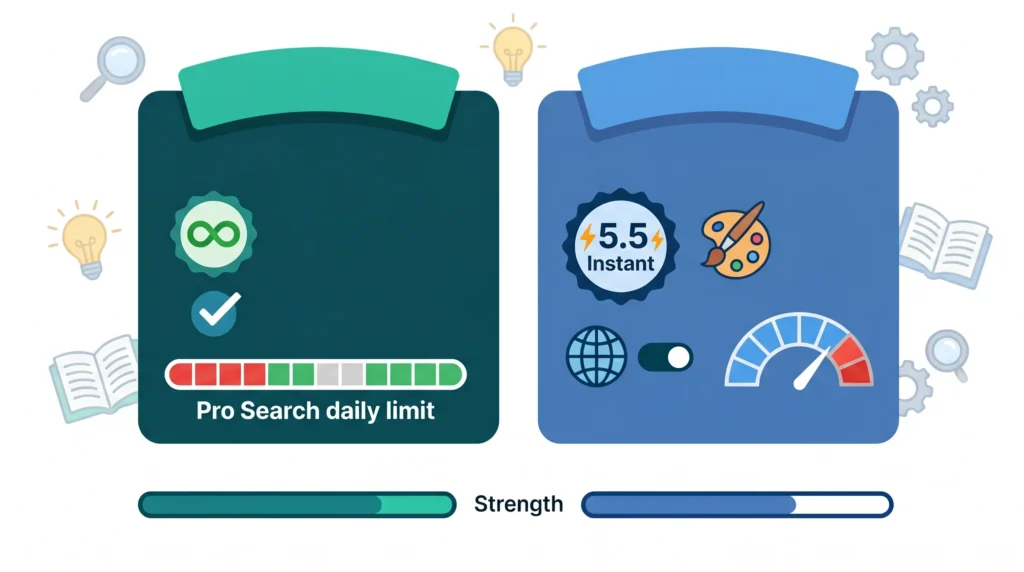
The Perplexity free tier provides unlimited standard searches with full citation functionality. This is the core value proposition, available at zero cost: ask any research question, get a sourced answer with clickable inline citations, repeat without hitting a daily wall. The limitation on the free tier is the number of Pro Search queries (deeper, multi-step research searches) per day, not standard searches.
Academic and domain-specific search modes are partially available on the free tier. The ability to search specifically within academic databases, patent filings, and specialized knowledge sources is limited but present.
ChatGPT Free Tier:
The ChatGPT free tier provides access to GPT-5.5 Instant with daily usage limits. Web search is available on the free tier, but the integration is less reliable than on the paid tier: browsing sometimes activates and sometimes does not on queries where it would be useful.
For research specifically, the free ChatGPT tier is most useful for tasks that do not require current information: analyzing documents you upload, synthesizing established knowledge, or reasoning through a complex problem from your own materials.
Free tier verdict for research: Perplexity’s free tier is the stronger option for ongoing research work. Unlimited standard searches with full citations at zero cost cover the majority of research needs for students, bloggers, and knowledge workers. ChatGPT’s free tier complements this for tasks Perplexity is not designed for: drafting, analysis, and generation work.
Perplexity Pro vs ChatGPT Plus: The $20/Month Decision
Is Perplexity Pro Worth $20/Month vs ChatGPT Plus for Research?
Both paid plans cost $20 per month. They are worth very different things depending on your primary use case.
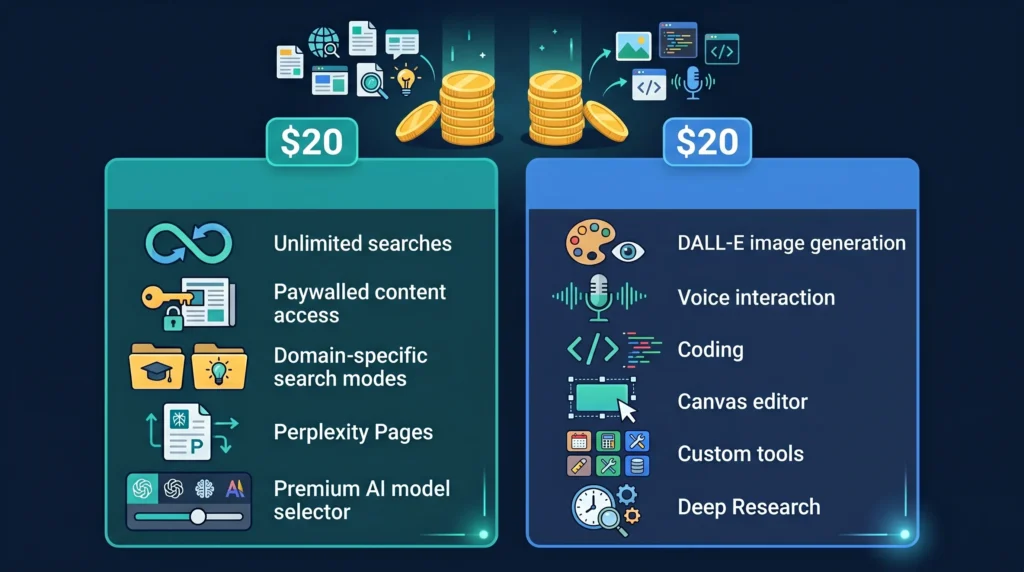
Perplexity Pro at $20/month includes:
- Unlimited Pro Search queries (multi-step deep research mode)
- Access to premium AI models for answering: GPT-5.4 and Claude Sonnet 4.6 as backend options
- Perplexity Pages: research reports generated as shareable, formatted documents
- Access to paywalled content, including research papers, financial reports, and premium publications
- Domain-specific search modes for academic, patent, and specialized databases
- Perplexity Computer: agentic research that manages multi-step research projects autonomously
ChatGPT Plus at $20/month includes:
- Full GPT-5.4 and GPT-5.5 access without daily limits
- DALL-E image generation
- Advanced Voice Mode
- Code Interpreter for live code execution
- Canvas collaborative editing environment
- Deep Research mode (extended, multi-source research reports taking 10 to 25 minutes)
- Custom GPTs and the full plugin ecosystem
Which is a better value for researchers specifically:
Choose Perplexity if you want a best-in-class research assistant: real-time search results, consistent citations, and domain-specific research environments for fields like academia and patents. Perplexity also gives you access to stats and reports that are normally paywalled. Choose ChatGPT if you want a general-purpose AI assistant. It is a superb partner for creative projects, data analysis, and coding.
For someone whose primary AI use case is research: Perplexity Pro. For someone who uses AI for a wide range of tasks and research is one of several needs: ChatGPT Plus covers more ground overall, with Perplexity’s free tier covering the research-specific needs.
Deep Research Mode: When ChatGPT’s Synthesis Depth Becomes the Right Choice
ChatGPT Deep Research vs Perplexity Pro Search: Different Tools for Different Research Depths
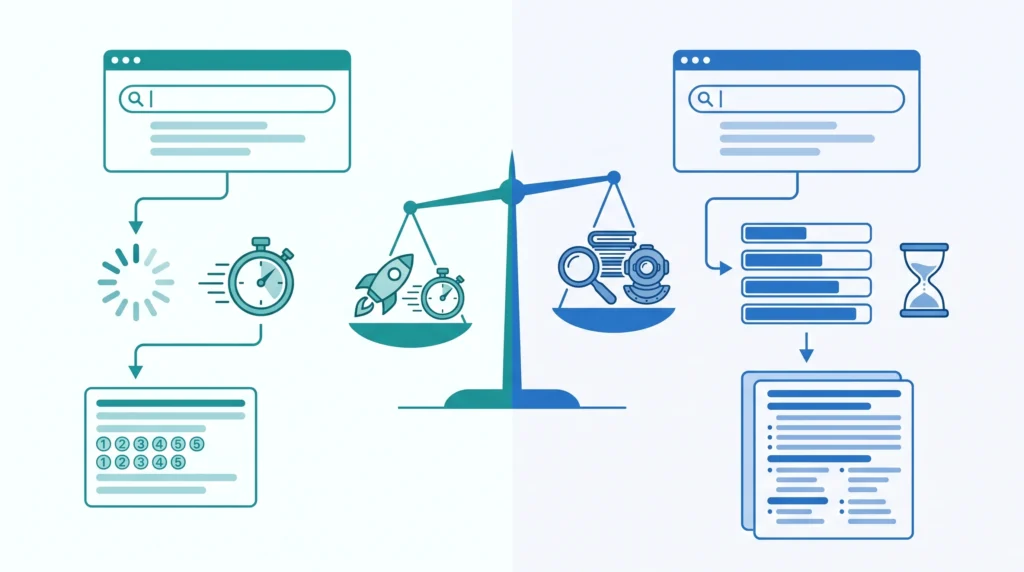
Perplexity Pro Search and ChatGPT Deep Research both produce multi-source research reports, but they operate at different speeds and depths.
Perplexity is the best starting point for most research: fast, accurate citations, and clear sourcing. ChatGPT Deep Research produces longer and more synthesized reports, but is slow and limited to paying users.
The practical distinction is the time-to-answer trade-off. Perplexity Pro Search returns a sourced, synthesized answer in 30 to 90 seconds. ChatGPT Deep Research takes 10 to 25 minutes per query but produces a significantly longer, more synthesized report that reads more like a commissioned research brief.
Use Perplexity when you are preparing for a meeting and need quick context, you want to fact-check something before you repeat it, you are monitoring what is happening in your industry this week, or you need a sourced answer in under two minutes. It is fast, it cites sources clearly and in line, and its accuracy on current events is strong.
Use ChatGPT Deep Research when you need a comprehensive, synthesized overview of a complex topic that requires pulling together many sources into a structured report. The depth and synthesis quality of a 25-minute Deep Research query is meaningfully higher than Perplexity’s faster output; the time cost is the trade-off.
For students, as described in the Gemini vs ChatGPT for students: which AI tool is actually more useful guide, the choice depends on the assignment type: Perplexity for quick source-finding and fact-checking; ChatGPT Deep Research for comprehensive topic overviews that need to be synthesized into a structured paper.
Where ChatGPT Beats Perplexity for Research-Adjacent Tasks
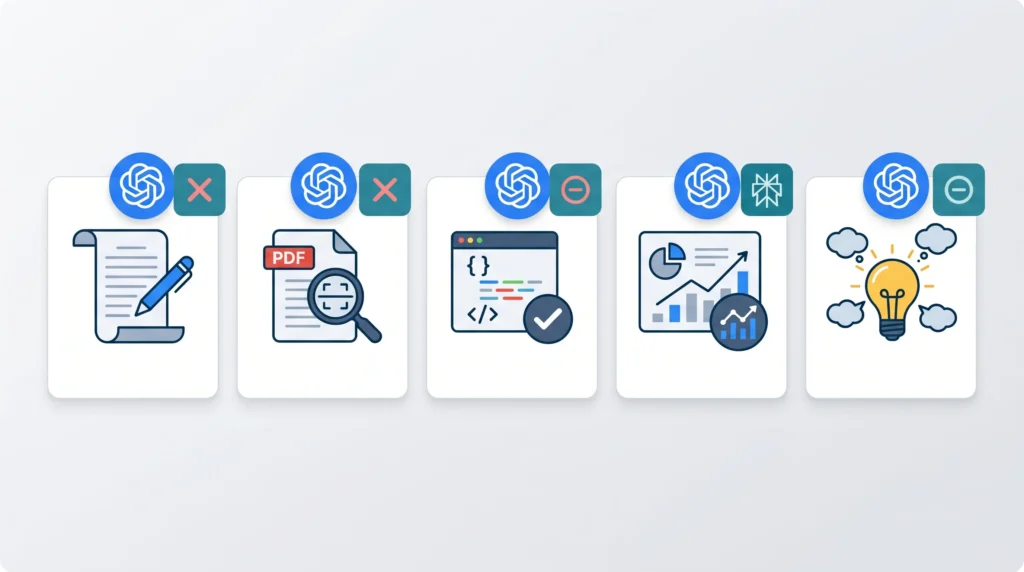
Perplexity is built for search and retrieval. For the tasks that surround research, including writing up findings, structuring arguments, analyzing data, and creating the deliverable the research feeds into, ChatGPT is the stronger tool.
ChatGPT outperforms Perplexity when:
- You need to draft the actual document that research findings will appear in: a report, article, proposal, or analysis
- You are analyzing a large document you have uploaded: a PDF, spreadsheet, or dataset
- You need to reason through complex, multi-step logical problems where the answer requires synthesis rather than retrieval
- You are coding, debugging, or working with data visualization alongside research
- The research task involves creative interpretation of sources rather than verification of facts
Perplexity does not write long-form documents, analyze uploaded files, generate images, or execute code. It finds and cites information from the web. For the work that happens after the research is gathered, ChatGPT handles it significantly better.
For freelancers and content creators building income around AI tools, as described in the AI tools for freelancing on Fiverr and Upwork and AI tools to make money online without investment guides, the practical workflow is: Perplexity to research and verify facts, ChatGPT to write and structure the deliverable.
Frequently Asked Questions
Q. Is Perplexity AI better than ChatGPT for research overall?
For research that requires verifiable, sourced, current information: yes. Perplexity’s inline citation system, real-time web access by default, and lower citation hallucination rate make it structurally better suited for research work. For research that feeds into writing, analysis, or generation tasks: ChatGPT handles the downstream work more effectively. Most serious researchers use both.
Q. Does Perplexity AI hallucinate less than ChatGPT?
On citation accuracy specifically, Perplexity has a lower citation error rate (37 percent) than ChatGPT Search (67 percent), according to independent testing. Both tools still hallucinate, and both require verification of important claims before they are used in serious work. Perplexity is more transparent about what it is sourcing from; it does not eliminate the problem.
Q. Is the Perplexity free tier genuinely useful, or does it require an upgrade?
Perplexity’s free tier is genuinely useful for most research needs. Unlimited standard searches with full inline citations at zero cost cover the majority of everyday research workflows. The upgrade to Pro ($20/month) is worth it specifically if you need unlimited Pro Search queries, paywalled content access, or the Perplexity Pages document feature.
Q. What is Perplexity Pro Search, and how does it differ from standard search?
Pro Search is Perplexity’s multi-step research mode. Rather than answering a query in a single search pass, it breaks the question into multiple sub-queries, searches each one, and synthesizes a more comprehensive answer. It uses premium AI models (GPT-5.4 or Claude Sonnet as the backend) and produces deeper results. The free tier limits the number of Pro Search queries per day; Perplexity Pro removes this limit.
Q. Can Perplexity replace Google for research?
For many research tasks, yes. Perplexity’s answer engine returns a synthesized, cited response faster than the traditional Google-then-click-multiple-links workflow. For tasks that require browsing full pages, finding images, accessing regional-specific content, or navigating complex site structures, Google’s direct access is still more practical. Perplexity accelerates the research phase; it does not replicate every use case of a full search engine.
Q. Is ChatGPT Deep Research better than Perplexity Pro Search?
They solve different problems at different speeds. ChatGPT Deep Research produces longer, more synthesized reports (10 to 25 minutes per query) that read like commissioned research briefs. Perplexity Pro Search delivers sourced answers in 30 to 90 seconds. For quick, sourced fact-finding: Perplexity. For comprehensive topic overviews with extended synthesis: ChatGPT Deep Research. Both require a paid plan to access fully.
Q. Which tool is better for academic research and citation?
Perplexity, with specific caveats. It surfaces academic sources, links to papers, and provides inline citations that make source verification faster. The Academic search mode on Perplexity Pro prioritizes peer-reviewed sources. The caveat: always verify citations independently before including them in academic work. Both tools can misattribute or fabricate citations; Perplexity does it less often, but it still happens.
Q. Does Perplexity have a mobile app?
Yes. Perplexity has iOS and Android apps that provide the same search and citation functionality as the web version. The mobile experience is well-designed for quick research queries on the go. ChatGPT also has mobile apps with full feature access on both platforms.
Q. Can I use Perplexity for content creation and blogging?
Perplexity is useful for the research phase of content creation: finding current sources, verifying facts, and identifying what has been written on a topic recently. For writing the actual content, structuring the article, and producing the final copy, ChatGPT or Claude are significantly better suited. The workflow that most content creators use is Perplexity for sourcing and ChatGPT or Claude for writing, as covered in the best AI for writing in 2026: which tool actually produces the best content guide.
Q. Which tool should a student use first: Perplexity or ChatGPT?
Start with Perplexity for any research task: essays, homework questions, finding sources for papers. It provides verifiable information with citations that you can check and properly attribute. Once the research is gathered and verified, use ChatGPT to help structure and write the assignment, following your institution’s AI use policy. This sequence separates research (where citation accuracy matters most) from writing (where generation capability matters most).
The Honest Verdict: Which One for Research
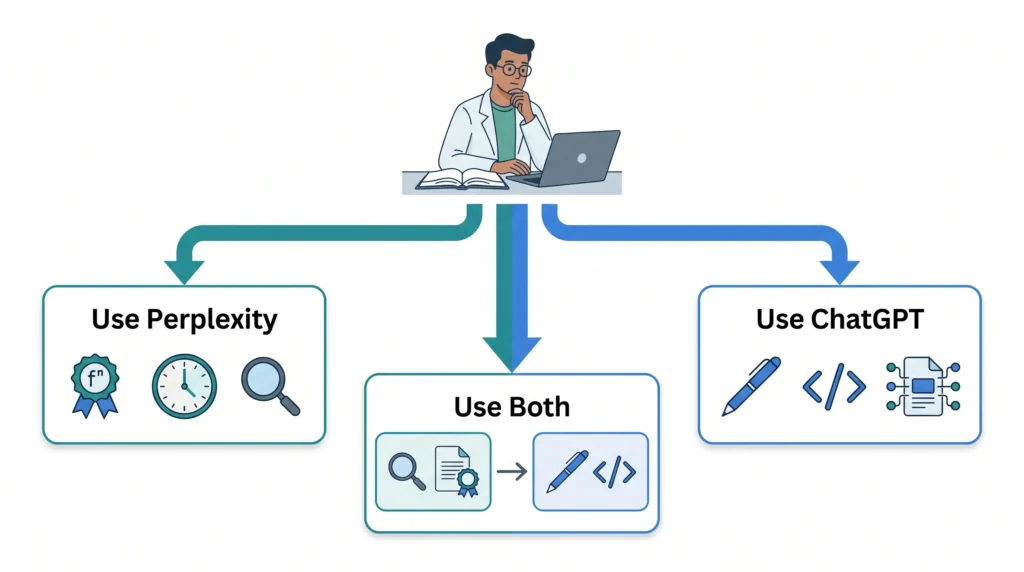
Use Perplexity as your primary research tool if:
- You need sourced, verifiable answers with inline citations
- Your work requires current information published within the last few days or weeks
- You are fact-checking specific claims before repeating them
- You are monitoring developments in a fast-moving field
- You research frequently, and the free tier’s unlimited standard searches cover your volume
Use ChatGPT for research when:
- You need deep synthesis across many sources in a single long-form report (Deep Research mode)
- The research feeds into writing, analysis, coding, or document creation work that you will do in the same session
- You are analyzing uploaded documents or datasets alongside web research
- Your research task requires creative interpretation rather than source verification
Use both when: Your research workflow has two distinct phases: finding and verifying information, then writing and structuring the output. Perplexity handles the first phase more reliably; ChatGPT handles the second more powerfully. Most knowledge workers, journalists, bloggers, and students doing serious research work are already using this combination.

Final Thoughts
Perplexity AI vs ChatGPT for research does not have a universal winner because they are genuinely different products serving different needs. Perplexity is a better research tool, specifically for finding sourced, current, verifiable information efficiently. ChatGPT is a better general assistant, specifically for the generation, analysis, and creation work that research feeds into.
The free tier of Perplexity is the strongest single recommendation for anyone who researches regularly and has not tried it yet: unlimited sourced searches at zero cost is a genuinely useful capability that most research workflows benefit from immediately. For the writing work on top of that research, the tools covered in previous guides, particularly Claude and ChatGPT, continue to lead.
The two tools are not competitors in the way that, say, ChatGPT and Claude are competitors. They sit at different points in the same workflow. Understanding that changes how productively you use both.