

ChatGPT vs Claude: Which is better in 2026? It is one of the most searched AI questions of the year, and almost every article ranking for it has a problem. Most were written in 2024, before GPT-5 and Claude 4 changed the comparison entirely. The ones that are current are either sponsored by companies that sell one of the tools or written by developers for developers, leaving out the freelancers, students, content creators, and business owners who make up the majority of people actually asking the question.
This comparison is different. Both tools were tested across the same tasks. Neither has been promoted here. The goal is to give you a clear, task-by-task answer so you stop reading comparisons and start using the right tool.
The short answer, before the detail: neither ChatGPT nor Claude is better across the board. They have diverged in focus. Anthropic optimised Claude for depth, precision, and quality in knowledge work. OpenAI optimised ChatGPT for breadth, ecosystem, and accessibility across every modality. Which one is better depends entirely on what you are doing.
If you have read the guides on AI tools for freelancing on Fiverr and Upwork, AI tools that replace a virtual assistant, best free AI tools for students, or AI tools to make money online without investment, you already use AI for practical income-generating and study purposes. This comparison tells you specifically which tool serves those purposes better, and at what price point.
Free Tier Comparison: What You Actually Get Without Paying
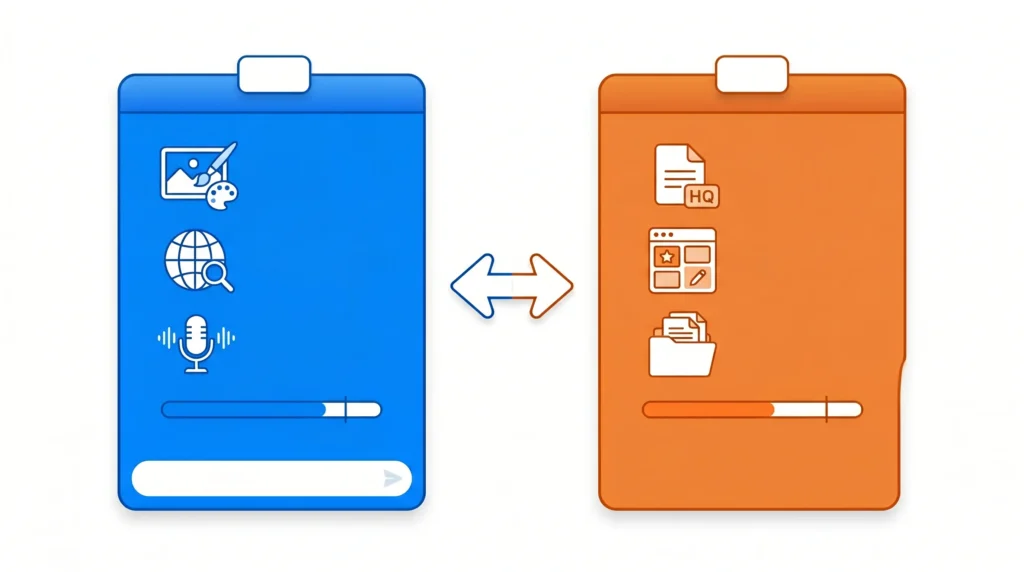
ChatGPT vs Claude: Which Is Better in 2026, Starting With the Free Options
Most people start with the free tier and upgrade only if they hit consistent limitations. The free tiers of both tools in 2026 are genuinely useful, but they are useful in different ways.
ChatGPT Free Tier (May 2026):
The ChatGPT free tier now defaults to GPT-5.5 Instant, a lightweight version of the GPT-5.5 architecture. This is a meaningful upgrade from what free users had a year ago. The free plan includes:
- GPT-5.5 Instant access with daily usage limits
- DALL-E image generation with a limited number of images per day
- Web search access for current information
- Voice mode (limited)
- Memory feature to retain preferences across sessions
The practical limitation is daily usage caps that most active users hit within a few hours of regular use. For casual tasks, the free tier is adequate. For daily work, the limits become frustrating quickly.
Claude Free Tier (May 2026):
The Claude free tier provides access to Claude Sonnet 4.6, which performs at near-Opus level on most everyday tasks. The free plan includes:
- Claude Sonnet 4.6 with usage limits that reset daily
- Artifacts feature: generates documents, code files, and structured outputs in a side panel
- Projects feature: organises conversations by context
- No image generation capability at any tier
The honest limitation of Claude’s free tier is that it hits usage limits faster than ChatGPT’s free tier does during intensive sessions. Heavy users report hitting the cap mid-session, which interrupts workflow. For lighter daily use, however, Claude Sonnet 4.6 on the free tier is one of the strongest free AI tools currently available.
Free tier verdict: ChatGPT wins on feature breadth at zero cost (image generation, web search, voice mode). Claude wins on output quality per interaction at zero cost. If you primarily write and analyse, Claude’s free tier delivers better results. If you need image generation or real-time web access for free, ChatGPT delivers better results.
Writing Quality: Where the Difference Is Most Consistent

ChatGPT vs Claude for Writing: The Most Important Category for Most Users
This is the category where Claude’s advantage is most consistent and most clearly documented. The phrase that comes up repeatedly across independent evaluations is that Claude produces text that sounds like a person edited it, while ChatGPT produces text that sounds like a competent AI wrote it. That distinction matters in practice.
What Claude does better in writing:
- Follows multi-constraint briefs more precisely: if you specify tone, word count, format, and audience simultaneously, Claude adheres to all four more reliably than ChatGPT
- Produces longer, coherent documents without structural drift: for anything over 800 words, Claude maintains voice and argument structure more consistently
- Matches editorial tone: marketing copy, client-facing proposals, and professional correspondence read more naturally from Claude
- Catches its own errors more proactively: Claude is more likely to flag uncertainty in its own output rather than stating incorrect information confidently
What ChatGPT does better in writing:
- Speed and structured content at volume: for producing multiple short-form pieces quickly, ChatGPT generates output faster and handles templated content reliably
- Brainstorming and ideation: ChatGPT’s responses in creative brainstorming sessions tend to be broader and more varied, covering more angles per prompt
- Image-paired content: when a piece of writing needs an accompanying visual, ChatGPT can generate both in the same conversation without switching tools; Claude cannot generate images at all
For freelancers producing client content, as covered in the AI tools for freelancing on Fiverr and Upwork guide, Claude’s instruction adherence is particularly valuable: clients specify requirements, and a tool that follows them precisely reduces revision rounds. For content creators who need speed and volume, ChatGPT’s pace advantage matters more.
Writing verdict: Claude wins for quality, precision, and long-form work. ChatGPT wins for speed, volume, and when images are part of the deliverable.
Coding: The Category Where Claude Holds the Clearest Lead

Is Claude Better Than ChatGPT for Coding in 2026?
Yes, on the available evidence, Claude holds a consistent and meaningful lead in coding as of mid-2026.
Claude Opus 4.6 scored 80.8 percent on SWE-bench Verified, the benchmark that tests performance on real GitHub issues from production codebases. Claude Opus 4.7 pushed this to 87.6 percent. GPT-5.4 sits at approximately 80 percent on the same benchmark, with GPT-5.5 scoring competitively in agentic coding workflows. The gap at the top is narrow, but Claude has held the lead consistently since early 2026.
In practical terms, this shows up as:
- Claude produces cleaner, more idiomatic code: better variable naming, cleaner structure, and stronger adherence to language-specific best practices
- Claude is more reliable in complex debugging: for multi-step refactoring or architectural decisions, Claude’s reasoning process produces fewer silent errors
- Claude Code (included in the Claude Pro plan at $20/month) is a terminal-based coding agent that handles multi-step programming tasks autonomously: this is a significant practical feature not available on the standard ChatGPT Plus plan
- Claude’s 200,000-token context window means it can hold an entire codebase in context simultaneously, making cross-file debugging and refactoring significantly more reliable
Where ChatGPT still competes in coding:
- Code Interpreter: ChatGPT can actually execute Python code in the session and show live results, which Claude cannot do in standard chat
- Breadth of framework knowledge: for less common or very new libraries, ChatGPT’s vast training data sometimes covers ground that Claude does not
- Speed: ChatGPT tends to respond faster on straightforward code generation tasks
Coding verdict: Claude is the better coding tool for serious development work. ChatGPT remains competitive for quick scripts, Python execution in-session, and when breadth matters more than depth. Students studying computer science, as described in the best free AI tools for students guide, will find Claude Sonnet 4.6’s free tier genuinely strong for debugging and code explanation.
Research and Accuracy: Knowing When Each Tool Lies to You
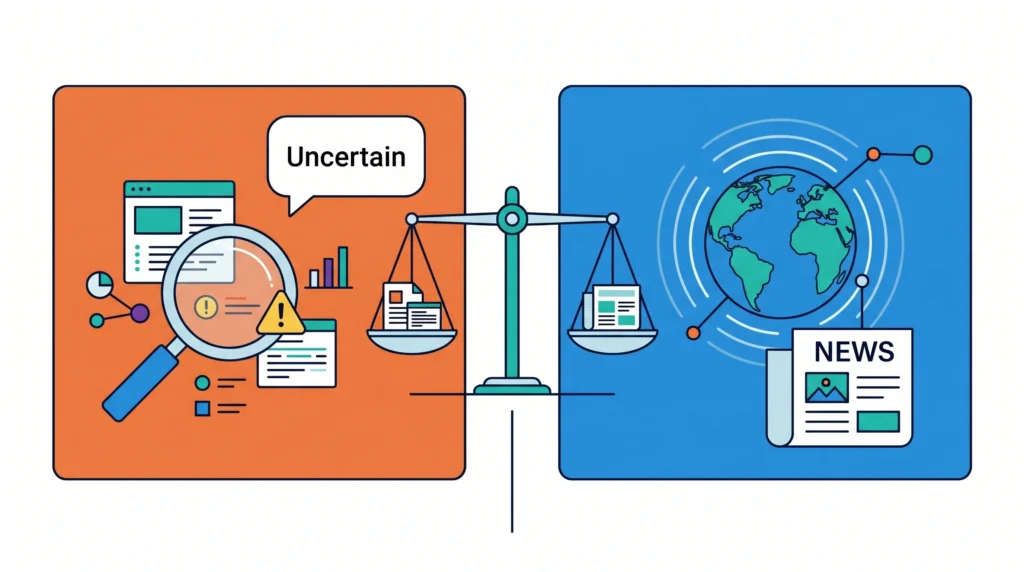
ChatGPT vs Claude for Research: Understanding Where Each Tool Fails
Both tools make mistakes. The pattern of those mistakes differs, and understanding that pattern matters more than knowing which one is “more accurate” overall.
Claude’s accuracy pattern:
Claude is more likely to acknowledge uncertainty. When it does not know something, it tends to say so rather than generating a plausible-sounding answer. On TruthfulQA, a benchmark specifically designed to catch models producing confident-sounding falsehoods, Claude Opus 4.6 consistently outperforms the GPT-5.x models. For analytical tasks and reasoning, Claude’s output contains fewer subtle logical errors.
ChatGPT’s accuracy pattern:
ChatGPT GPT-5.4 leads on SimpleQA, which tests factual recall of specific, verifiable information. Its web search capability, available even on the free tier, means it can retrieve current information accurately rather than relying on training data that has a cutoff date. For questions about recent events, current pricing, or anything that has changed in the past twelve months, ChatGPT with web search is significantly more reliable.
The practical implication:
For research involving current events, real-time data, or recent developments: ChatGPT with web search enabled. For deep analytical reasoning, document analysis, and tasks where logical consistency matters: Claude. For both simultaneously, use ChatGPT for sourced current-web research and Claude for analysis of those findings.
Business owners using AI for operational tasks, as covered in the AI tools that replace a virtual assistant guide, will find ChatGPT’s live web access more useful for tracking current information, while Claude handles the analytical and document-drafting work more reliably.
Context Window: What the Numbers Mean in Practice
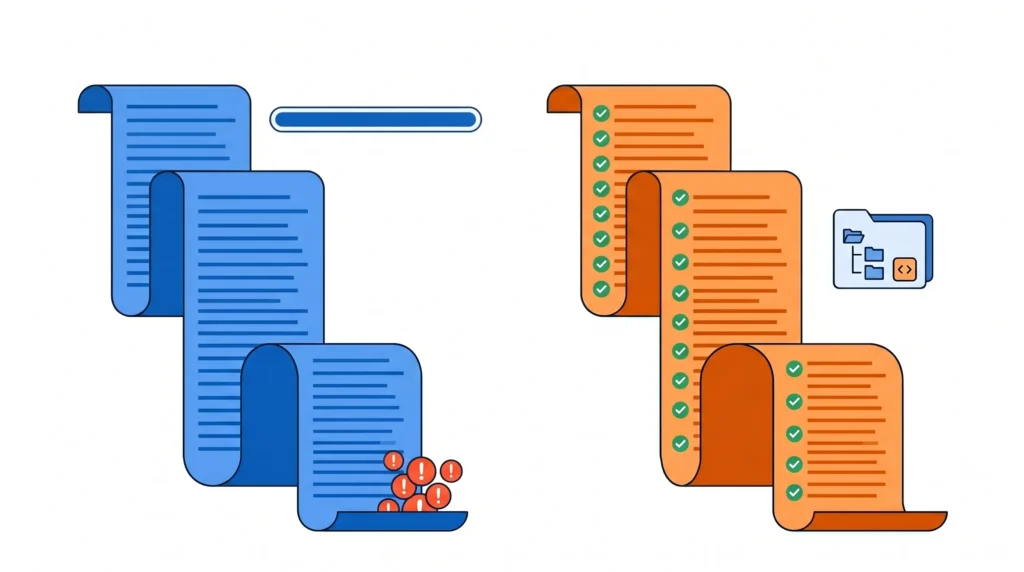
Claude vs ChatGPT Context Window: Why It Matters for Real Work
Context window is one of the most misunderstood specifications in AI comparisons. Here is what the numbers mean practically.
Claude’s context window:
Claude Opus 4.6 supports a 200,000-token context window in standard use, with a 1,000,000-token context available in beta. In practical terms, 200,000 tokens is roughly 150,000 words; about 700 pages of text in a single conversation. Claude Opus 4.7 supports 128,000 token output per response, meaning it can generate an entire long-form document without truncating.
ChatGPT’s context window:
GPT-5.4 also supports a 1,050,000-token input context, matching or exceeding Claude on raw numbers. The practical difference appears in how reliably each model uses that context: Claude’s recall and reasoning across long documents is consistently rated higher by developers working with full codebases or large document collections.
What this means if you upload a 50-page contract or a full codebase:
Claude processes it more reliably. It is less likely to lose track of information from the beginning of a document when answering questions about content near the end. For the document management and VA task replacement use cases described in the AI tools that replace a virtual assistant guide, this context reliability matters directly.
Pricing: What Each Plan Actually Includes at $20 Per Month
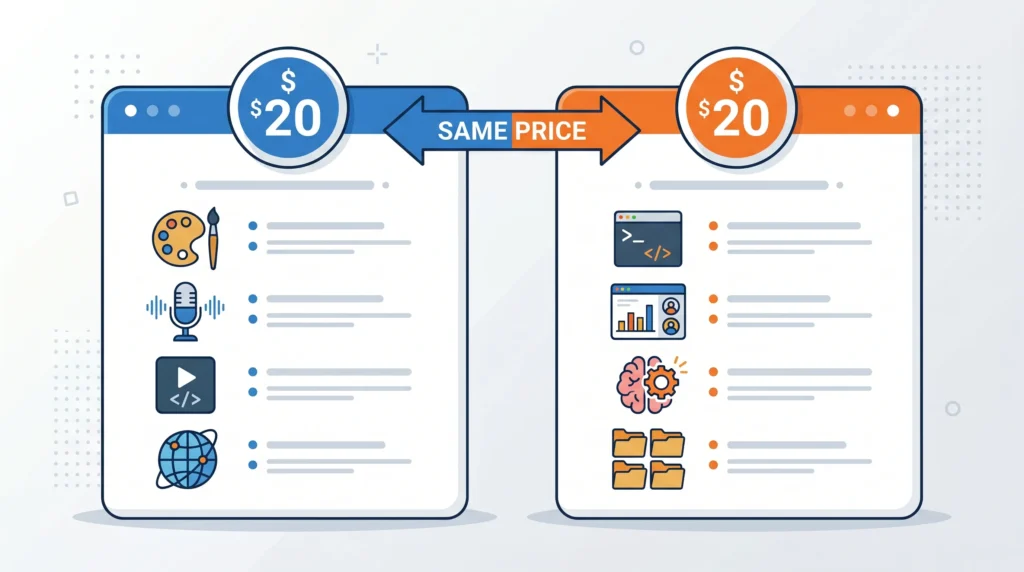
Both ChatGPT Plus and Claude Pro cost $20 per month. The value proposition of each plan differs significantly.
ChatGPT Plus at $20/month includes:
- Full access to GPT-5.4 and GPT-5.5 without daily limits
- DALL-E image generation
- Advanced Voice Mode
- Code Interpreter for live code execution
- Web search without restrictions
- Custom GPTs and the full plugin ecosystem
- Memory features
Claude Pro at $20/month includes:
- Full access to Claude Opus 4.6 without daily limits
- Claude Code: a full terminal-based coding agent
- Cowork feature: a desktop application for file and task automation
- Extended Thinking mode: shows Claude’s reasoning process before the final answer
- Projects: persistent context organised by client or topic
- Priority access during peak hours
Which plan offers more value depends on your primary use case:
If you generate images, use voice mode frequently, or need live code execution: ChatGPT Plus. If you write long documents, work with code at a serious level, or need the Claude Code agent: Claude Pro. Both at $20 per month represent strong value relative to what professional freelancers spend on other tools.
For anyone using AI tools to generate income online, as described in the AI tools to make money online without investment guide, $20 per month on the right subscription typically returns that cost within a few hours of client work, making the upgrade decision straightforward once your workflow is established.
Image Generation: A Category Where Only One Tool Competes
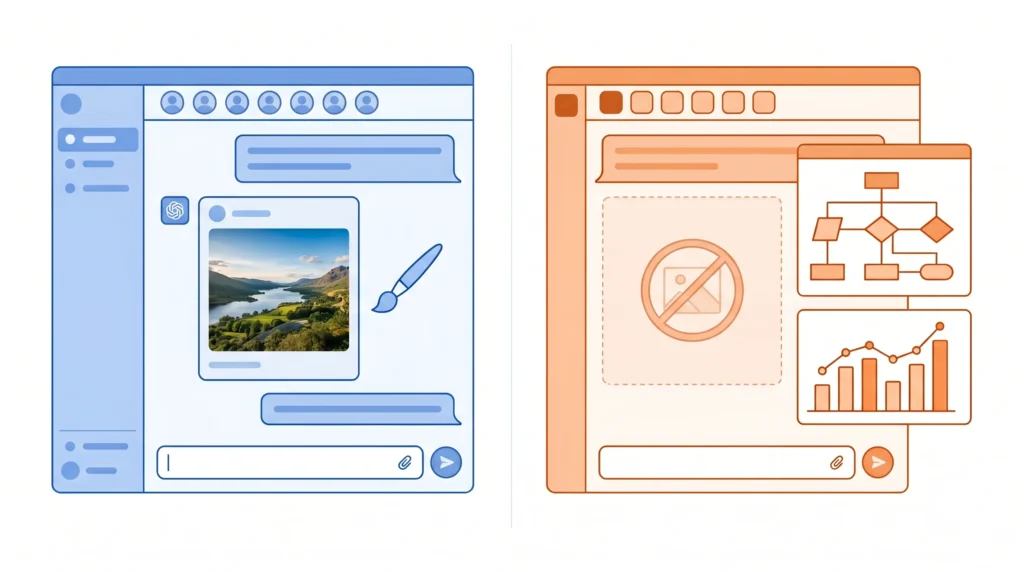
Claude does not generate images at any tier. Not on the free plan, not on Pro, not on the Max plan at $100 to $200 per month. It can create SVG diagrams, charts, and code-generated visuals, but photographic or illustrated image generation is not a Claude capability.
ChatGPT Plus includes DALL-E 3 image generation, which improved significantly with the GPT-5 series. For freelancers offering content packages that include visual assets, bloggers who need featured images, or anyone whose workflow involves image creation alongside text, this matters.
If image generation is part of your regular work, ChatGPT has no equivalent competition from Claude. For the free image generation alternatives covered in the best free AI image generator for beginners guide, Adobe Firefly and Bing Image Creator remain the strongest zero-cost options regardless of which AI assistant you use for text.
Privacy: Which Tool Handles Your Data More Conservatively

This section matters for anyone using AI tools with client information, confidential business data, or sensitive documents.
Claude’s privacy defaults:
Anthropic’s privacy policy applies more conservative defaults across all tiers. Claude does not use conversations to train its models by default; you do not need to locate a settings page and disable data sharing. For professionals handling client files, legal documents, or financial information, this default-off approach to training data use is practically relevant.
ChatGPT’s privacy settings:
OpenAI allows users to opt out of having conversations used for model training through the settings menu. The opt-out is available and works as described; it simply requires an active choice rather than being the default. Enterprise and Team plans include stronger privacy guarantees than the individual Plus tier.
Privacy verdict: Claude’s conservative defaults require less configuration to protect sensitive work. ChatGPT’s privacy is configurable to an equivalent level, but requires user action.
The Honest Summary: When to Use Each Tool
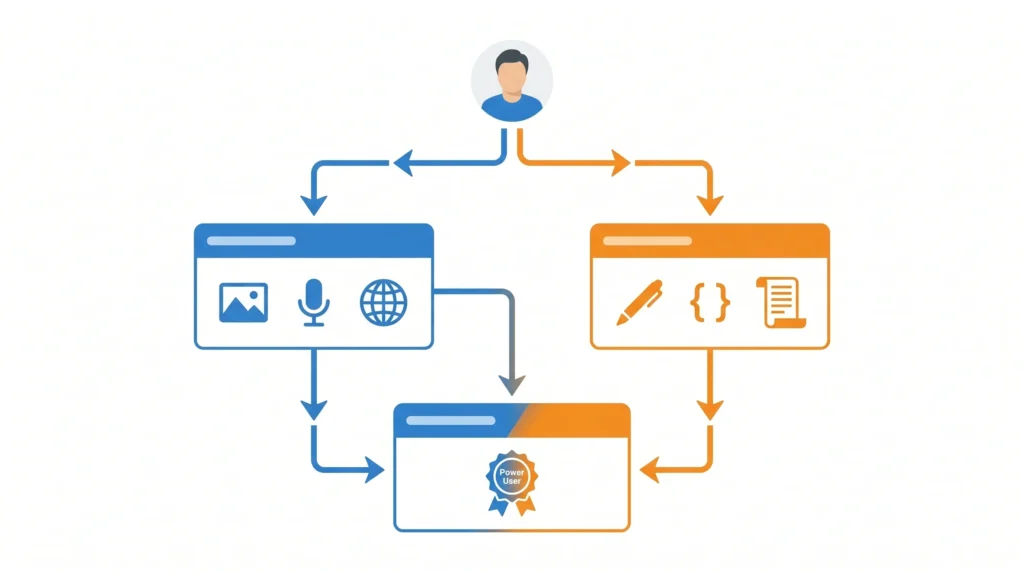
Rather than a single winner, here is the clear decision framework:
Use Claude when:
- Writing quality matters: client proposals, marketing copy, long-form articles
- You are working with code: debugging, refactoring, and architectural decisions
- You have large documents to analyse: contracts, research papers, full codebases
- You need precise instruction following: multi-constraint briefs, editorial work
- Privacy defaults matter for your work
Use ChatGPT when:
- You need image generation as part of your workflow
- You need real-time web information without configuring anything
- You use voice mode regularly
- You need in-session code execution (Code Interpreter)
- You rely on the plugin and the Custom GPT ecosystem
- You are doing high-volume, varied tasks that benefit from breadth
Use both when: You are a serious user spending significant time in AI tools daily. At $40 per month total for both Pro plans, you get the best coding and writing AI (Claude) and the best multimodal feature set (ChatGPT). Route each task to the appropriate tool. This is what most power users who have tested both tools extensively settle on.
Frequently Asked Questions
Q. Is Claude better than ChatGPT for writing in 2026?
For quality, precision, and long-form work: yes. Claude Opus 4.6 and 4.7 produce more natural prose, follow complex briefs more accurately, and maintain coherence across longer documents. ChatGPT is faster and handles structured, template-based content better at volume. For client-facing writing where quality matters more than speed, Claude is the stronger tool. For brainstorming and high-volume short content, ChatGPT is competitive.
Q. Which tool has a better free tier in 2026?
They are strong in different ways. ChatGPT’s free tier offers more features: image generation, web search, and voice access. Claude’s free tier offers higher output quality per interaction with Claude Sonnet 4.6. If you primarily write and analyse documents: Claude. If you need image generation or real-time web access at zero cost, use ChatGPT.
Q. Can Claude generate images?
No. Claude does not generate images at any subscription tier. It can produce SVG code, charts, and diagrams in text format, but it cannot create photographic or illustrated images. Image generation requires ChatGPT (via DALL-E), or a dedicated free tool like Adobe Firefly, as covered in the best free AI image generator for beginners guide.
Q. Which AI is better for coding: ChatGPT or Claude?
Claude holds a consistent lead on coding benchmarks as of mid-2026. Claude Opus 4.6 scored 80.8 percent on SWE-bench Verified; Opus 4.7 scored 87.6 percent. Approximately 70 percent of developers in independent surveys prefer Claude for complex coding tasks. Claude Code, included in the $20/month Pro plan, is a full coding agent with no equivalent on standard ChatGPT Plus. For simple scripts and Python execution in-session, ChatGPT’s Code Interpreter remains useful.
Q. Is Claude Pro worth $20 per month over ChatGPT Plus?
If your primary use cases are writing, coding, and long-document analysis, Claude Pro at $20/month delivers more value than ChatGPT Plus. If your primary use cases involve image generation, voice mode, web browsing, or the Custom GPT ecosystem, ChatGPT Plus delivers more value. Both plans are strong enough that the right answer is determined by your actual daily workflow, not by which model scores higher on aggregate benchmarks.
Q. Does Claude have a web search?
Claude does not have native web search integrated in the same way ChatGPT does. Claude.ai has limited web access in some configurations, but it is less seamlessly integrated than ChatGPT’s web search. For real-time current information, ChatGPT with web search or Perplexity AI are more reliable tools.

Final Thoughts
The ChatGPT vs Claude question in 2026 does not have a single correct answer, and any article claiming otherwise is either oversimplifying or selling something. What does have a correct answer is: which tool is better for your specific tasks, at what price point, and with what limitations.
Claude wins on writing quality, coding depth, instruction precision, and conservative privacy defaults. ChatGPT wins on feature breadth, image generation, voice mode, live code execution, and real-time web access. Both cost $20 per month at the paid tier. Both have useful free tiers with different trade-offs.
If you spend most of your AI time writing, editing, and coding, start with Claude’s free tier, test it for two weeks, and decide from there. If you need images, voice, and live web access alongside text tasks, ChatGPT covers more ground in one tool. If you are a serious daily user and AI tools directly generate income for you, both subscriptions at $40 per month total is a straightforward decision once the first additional client project covers the cost.