
Gemini vs ChatGPT for students is one of those questions that gets a lot of confident answers online, most of them wrong. The articles ranking for this comparison are written by tech reviewers who tested both tools for twenty minutes on a laptop and declared a winner. They are not written by people who understand what a student’s actual Tuesday night before an exam looks like: multiple browser tabs, a Google Doc half-finished, a research question that needs a current source, and a math problem that the textbook explains badly.
That is what this comparison is actually about. Not benchmarks. Not API pricing. The question is: when you are a student trying to finish real academic work, which tool gets you there faster, more accurately, and without costing you anything?
Both tools have changed significantly since most of the existing comparisons were written. Gemini 3 is a meaningfully different product from Gemini 2.5. ChatGPT with GPT-5.4 handles multi-step reasoning far better than its predecessors. The free tier situation has also shifted, and for students specifically, that shift matters more than almost any other factor in this comparison.
If you have read the guides on best free AI tools for students, AI tools to make money online without investment, best free AI image generator for beginners, or ChatGPT vs Claude: which AI assistant is actually better in 2026, you already use AI regularly for practical purposes. This comparison gives you the specific, honest answer on which tool handles student work better, and where each one fails.
Free Tier for Students: Gemini Has a Significant Advantage in 2026

Gemini vs ChatGPT for Students: Starting With What Costs Nothing
Most students are not paying $20 per month for an AI subscription. The free tier comparison is, therefore, the most practically important part of this entire article.
ChatGPT Free Tier for Students (May 2026):
The ChatGPT free tier provides access to GPT-5.5 Instant, a lighter version of the GPT-5.5 architecture with daily usage caps. For most students, those caps become limiting within a few hours of active study use. Web search is available on the free tier, which is useful for current research. Image generation via DALL-E is accessible in limited quantities. Voice mode is available but restricted.
The core limitation is that GPT-5.4 access on the free tier is metered; heavy users hit daily limits before finishing a full study session.
Gemini Free Tier for Students (May 2026):
Gemini gives free users access to Gemini 3 Flash, its capable lightweight model, without the aggressive daily limits that ChatGPT imposes. More significantly, Google AI Pro, which includes Gemini Advanced powered by Gemini 3.1 Pro, has been free for verified students for one year through an ongoing education program. This is the full, paid-tier model at zero cost for eligible students; an advantage that completely changes the value equation for anyone who qualifies.
Beyond raw model access, the free tier also includes NotebookLM, which is separately discussed below, and native integration with Google Drive, Docs, and Gmail without any additional configuration.
Free tier verdict for students: Gemini wins clearly. Full model access through the student program and fewer usage interruptions during active study sessions make it a stronger free option. For students who do not qualify for the education program, Gemini 3 Flash on the standard free tier still offers more consistent availability than ChatGPT’s metered GPT-5.4 access.
Essay Writing: A Closer Call Than Most Comparisons Admit
Gemini vs ChatGPT for Students Writing Essays: The Honest Assessment
Most comparisons declare ChatGPT the clear winner for essay writing based on writing quality alone. That conclusion is partially correct and partially misleading, because it ignores how students actually write essays.
Where ChatGPT is stronger for essay work:
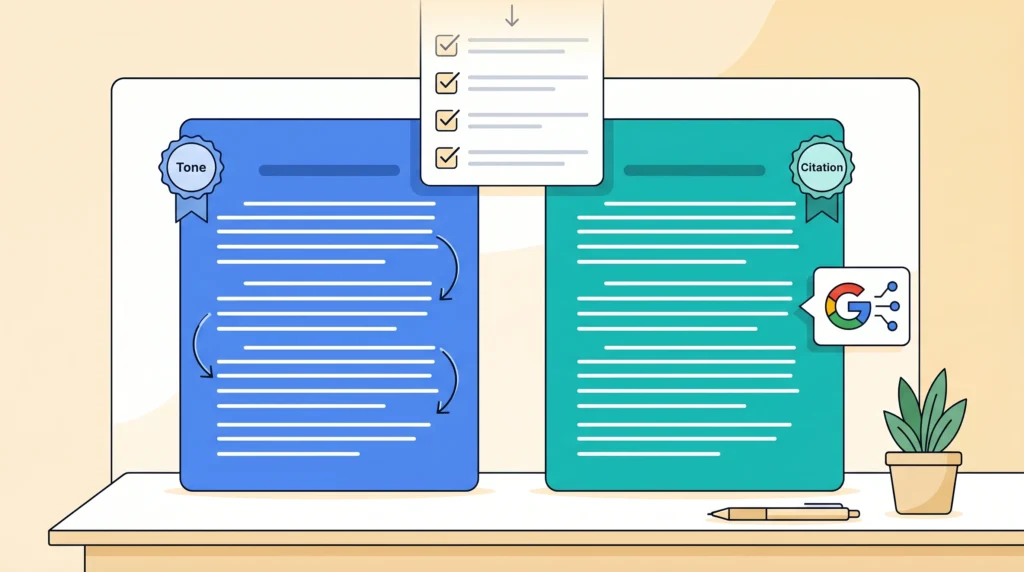
ChatGPT GPT-5.4 consistently produces stronger long-form prose. It maintains tone, transitions, and argument flow across a full essay more reliably than Gemini. When you ask it to write in a specific academic voice, follow a five-paragraph structure, or adapt a draft to match a rubric’s requirements, it follows those constraints more precisely. The output is more cohesive and requires less editing before it reads like a polished draft.
For essay outlines, argument structuring, and finding the logical flow of a complex argument, ChatGPT’s reasoning strength shows clearly. If you give it a thesis statement and three supporting claims, it builds a logically coherent argument around them without the structural drift that Gemini sometimes produces on longer pieces.
Where Gemini is stronger for essay work:
Gemini has real-time web access built into its standard interface, while ChatGPT’s web search requires explicit activation and is less consistently integrated. For essays that require current sources, recent statistics, or references to events from the last twelve months, Gemini’s ability to retrieve and cite current information directly is practically significant.
Gemini also integrates directly with Google Docs. If your essay draft lives in a Google Doc, you can ask Gemini to review it, suggest improvements, and make edits without copy-pasting between applications. For students whose entire academic workflow runs through Google, this integration is a genuine time-saver rather than a marginal convenience.
Essay writing verdict: Use ChatGPT for structuring arguments, maintaining tone, and drafting cohesive long-form content. Use Gemini when your essay requires current sources or when you are working directly within Google Docs and want to avoid switching applications.
Research: The Category Where Gemini’s Real-Time Access Matters Most
How Their Research Capabilities Differ for Academic Use
Research is where the two tools diverge most sharply in a way that matters specifically to students.
ChatGPT for research:
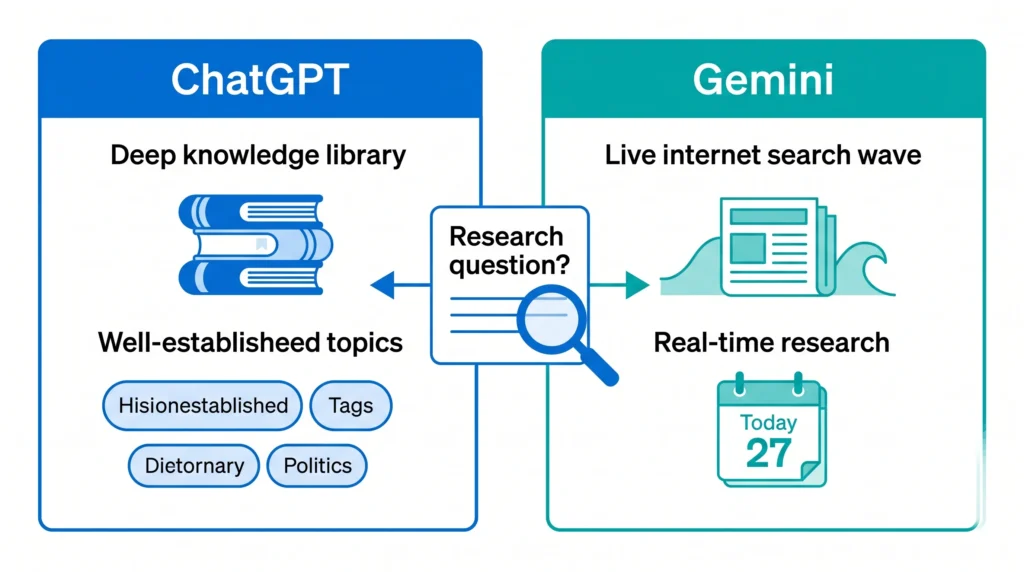
ChatGPT with web search enabled can access current information, but its training data cutoff still affects the quality of responses on topics where recent developments matter. For well-established subjects with decades of documented research (historical analysis, classical literature, foundational science), ChatGPT’s depth of training data is an advantage. It can explain complex established concepts with clarity and draw on a vast base of structured knowledge.
The limitation appears in current events, recent studies, policy changes, or any topic where what was true eighteen months ago differs from what is true today.
Gemini for research:
Gemini’s real-time search integration is more seamless. When you ask Gemini a research question, it searches the current web as part of the response process, retrieves recent sources, and incorporates that information directly into its answer. For social science assignments on current events, business case studies, science essays that reference recent publications, or any topic where currency matters, this is a meaningful practical advantage.
Gemini is also better at providing cited, sourced responses by default. It is more likely to tell you where information came from, which matters for students who need to verify claims before including them in academic work.
Research verdict: For current events, recent studies, and anything where information from the past twelve months is relevant, Gemini’s real-time access gives it a clear advantage. For deep, established subject matter where breadth of training data matters more than currency, ChatGPT performs strongly. Students writing literature reviews or historical analyses benefit from ChatGPT; students writing current affairs essays or science papers referencing recent journals benefit from Gemini.
Math and Science: Where ChatGPT Has Held a Consistent Edge
Gemini vs ChatGPT for Students on Math and Science Problems
For mathematics and science subjects, the comparison favors ChatGPT on complex, multi-step problems.
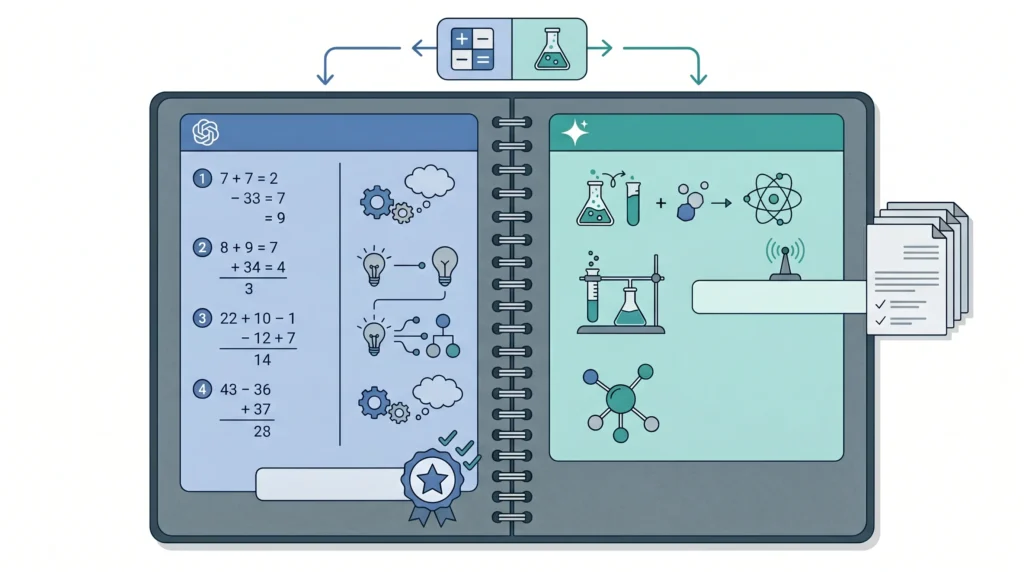
ChatGPT GPT-5.4 excels at multi-step mathematical problems, formal proofs, and problems requiring logical reasoning chains. It shows each step clearly, explains the reasoning behind each step, and can identify where a student went wrong when given an incorrect attempt. For calculus, linear algebra, statistics, physics problems, and chemistry equations, it handles complexity well and produces structured, step-by-step solutions that students can follow and learn from.
Gemini handles standard math and science questions competently and is improving rapidly. Its advantage over ChatGPT appears in science questions that benefit from the current research context: questions about recent discoveries, current scientific consensus on contested topics, or assignments that require referencing recent studies. For pure mathematics and established physics or chemistry, ChatGPT’s reasoning strength shows clearly.
A practical note: Both tools make mathematical errors on sufficiently complex problems. For high-stakes work, always verify AI-generated mathematical solutions against a textbook or instructor solution before submitting. The tools are most reliable for explaining concepts and walking through worked examples; less reliable as a sole source of truth on novel problems.
Math and science verdict: ChatGPT for complex multi-step problem solving, formal proofs, and established science subjects. Gemini for science questions that require a current research context or recent findings.
Google Workspace Integration: Gemini’s Most Practical Student Advantage

Why This Matters More Than Most Comparisons Acknowledge
The majority of students do their academic work inside Google’s ecosystem: Google Docs for essays, Google Slides for presentations, Google Drive for file management, and Google Classroom for submitting assignments. Gemini’s native integration with all of these applications is a practical advantage that benchmark comparisons consistently underweight.
With Gemini integrated into Google Docs, students can:
- Ask Gemini to review and improve a draft without leaving the document
- Request specific revisions (make this paragraph more concise, strengthen this argument) and have them applied directly
- Generate a first outline within the Docs interface before writing
- Ask for citation suggestions based on the content of the document
With Google Slides integration, Gemini can generate presentation structures, suggest content for each slide, and produce speaker notes from a topic description without any external tool switching.
ChatGPT does not have equivalent native integration with Google’s productivity suite. Students using ChatGPT must copy content from their documents into the chat interface, receive the response, and copy it back; a workflow that works but adds friction compared to Gemini’s in-document experience.
For students using Microsoft 365 instead of Google’s tools: ChatGPT Plus integrates with Microsoft’s productivity apps through Copilot in some configurations. If your academic institution uses Microsoft Teams and Word rather than Google Workspace, this partially levels the integration advantage.
Integration verdict: For Google Workspace users, which describes the majority of students working in non-Microsoft-365 institutions, Gemini’s integration is a practical time-saver for daily work.
Code Help for CS Students: A Closer Contest
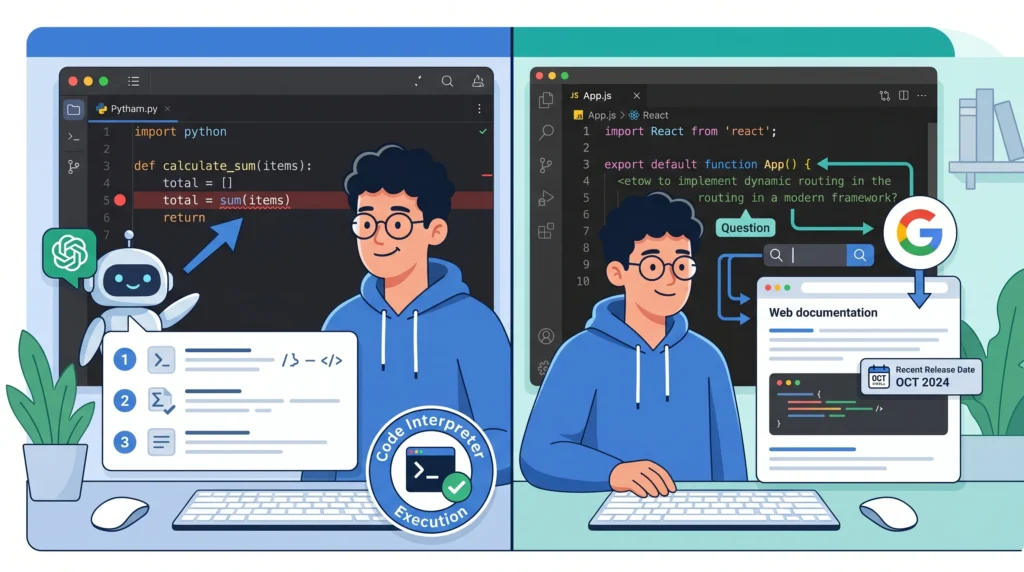
Gemini vs ChatGPT for Students Studying Computer Science
For computer science students needing help with code, both tools are useful, but they differ in how they deliver that help.
ChatGPT is strong on code explanation, debugging, and working through logical errors. It identifies where code goes wrong, explains why, and suggests a correction with clear reasoning. The Code Interpreter feature on the paid tier can actually execute Python code and show live results, which is genuinely useful for data science and algorithm testing.
Gemini is also capable of code tasks and offers the advantage of real-time search for documentation on very recent libraries or frameworks, where training data may be sparse. For students working with technologies that have changed significantly in the past year, Gemini’s ability to retrieve current documentation is useful.
For most standard CS coursework: debugging, data structures, algorithms, and basic software development, both tools perform similarly. The ChatGPT vs Claude: which AI assistant is actually better in 2026 guide covers the coding comparison in more depth, including where Claude outperforms both ChatGPT and Gemini on complex development work.
Code help verdict: Roughly even for standard coursework. ChatGPT has a practical edge for Python execution and established frameworks. Gemini has a practical edge for very recent libraries, and when staying inside the Google ecosystem matters.
NotebookLM: The Study Tool Most Students Are Not Using

This section deserves its own space because NotebookLM is one of the most genuinely useful free AI tools for students in 2026, and it is almost entirely overlooked in Gemini vs ChatGPT comparisons.
NotebookLM is a Google product, free to access, that lets you upload your own course materials: lecture slides, reading assignments, textbook chapters, and notes, and then ask it questions exclusively based on those materials. It cannot hallucinate information from outside what you have uploaded, which makes it significantly more reliable for exam preparation than either ChatGPT or Gemini in standard chat mode.
What students use NotebookLM for:
- Upload all lecture notes for a module and generate a complete revision summary
- Ask it to explain a concept from your own notes in simpler terms
- Generate practice questions based on your actual course content
- Create audio overviews of complex material for passive listening while commuting
Because it only draws on what you upload, it cannot invent sources, misremember course-specific content, or give you answers based on a different version of the textbook than your professor uses. This constraint makes it more trustworthy than open-ended AI chat for exam-specific revision.
The full guide on best free AI tools for students covers NotebookLM in more detail alongside other free study tools. If you have not tried it, it is worth making the first tool you set up before your next exam period.
Academic Integrity: What Students Need to Know Before Submitting AI-Assisted Work
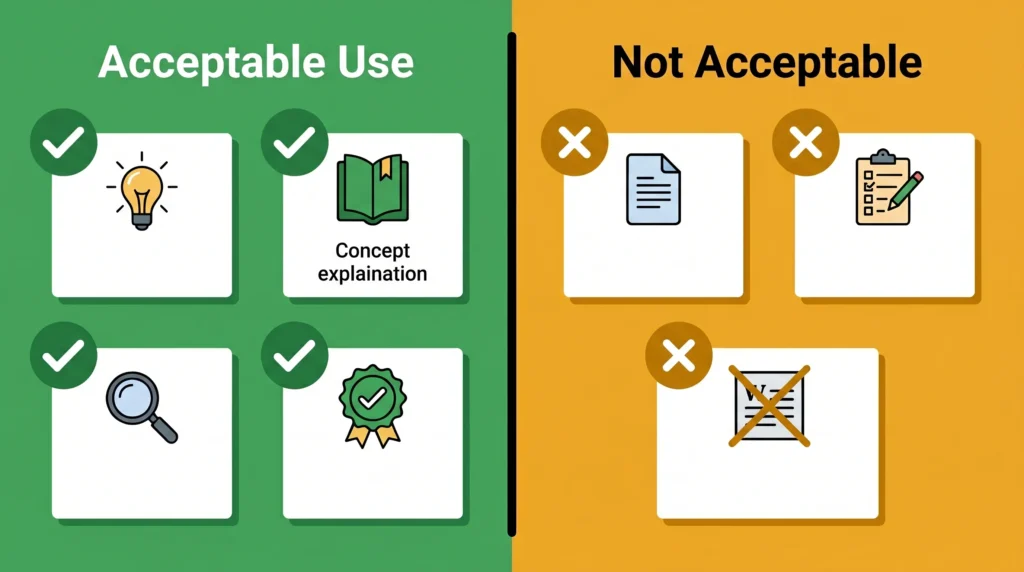
This section is not optional reading. Every student using AI tools for academic work needs a clear understanding of where the line is, because the consequences of getting this wrong are serious and the rules vary significantly between institutions.
What is generally acceptable across most institutions:
- Using AI to brainstorm ideas or generate an outline that you then develop yourself
- Using AI to explain a concept you do not understand from a lecture
- Using AI tools like Grammarly or similar for grammar and style checking
- Using AI to find sources that you then read and cite yourself
- Using NotebookLM to review your own uploaded notes for exam preparation
What is generally not acceptable:
- Submitting AI-generated text as your own work without disclosure, regardless of how heavily you edit it
- Using AI to complete assignments that are explicitly designed to assess your own skills
- Presenting AI-generated research findings without verifying the sources yourself
The practical reality in 2026:
Most universities have adopted nuanced policies that permit some AI use with disclosure rather than blanket bans. The specific rules at your institution matter more than any general guideline. When in doubt, ask your instructor directly before submitting. A five-minute clarifying conversation is significantly better than a misconduct process.
Both tools, used correctly for the acceptable purposes listed above, are legitimate academic aids. Used incorrectly, they create risk regardless of how sophisticated the tool is.
The Verdict: Which Tool to Use Based on Your Actual Study Situation
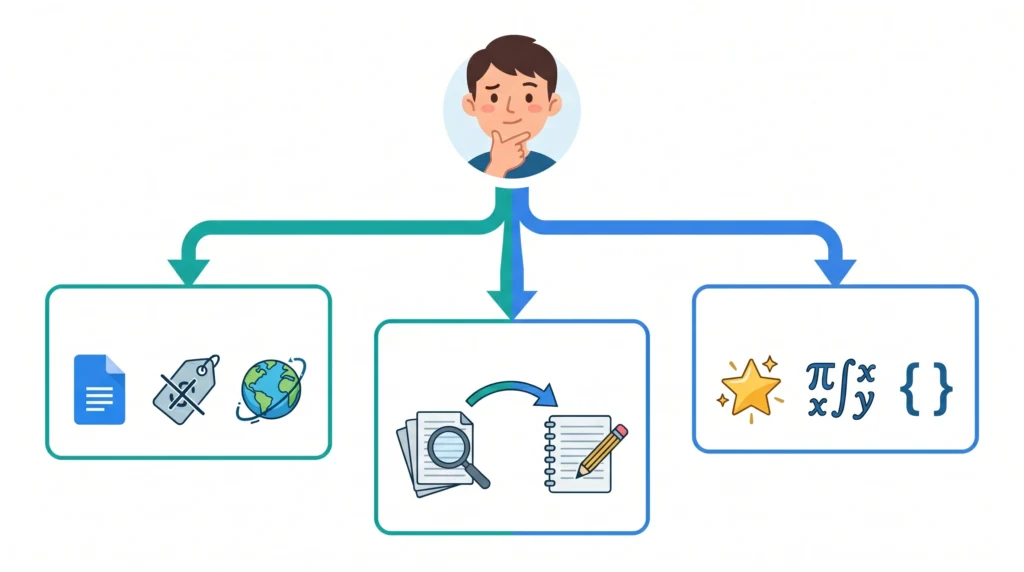
Rather than declaring one overall winner, here is the honest framework:
Choose Gemini as your primary tool if:
- You do most of your work inside Google Docs, Slides, and Drive
- You are eligible for the free Google AI Pro student program
- Your assignments frequently require current information or recent sources
- You want real-time search integrated into your research without switching tools
Choose ChatGPT as your primary tool if:
- Long-form essay quality and argument structure matter most to your workload
- You study mathematics, formal logic, or established sciences where depth of training data beats recency
- You are already paying for ChatGPT Plus and use its features across multiple use cases
- You need in-session code execution via Code Interpreter for Python work
Use both when: You are doing research-heavy work: use Gemini to find and verify current sources, then use ChatGPT to draft the essay structure and argument from those sources. This two-tool workflow takes five extra minutes to set up and produces better results than either tool alone.
For the free tier specifically, start with Gemini, particularly if you qualify for the student education program. The access to a full model at zero cost is a practical advantage that no benchmark comparison can change.
Frequently Asked Questions
Q. Is Gemini or ChatGPT better for writing essays as a student?
ChatGPT produces stronger long-form essay prose: better tone, argument flow, and instruction adherence. Gemini has the advantage when your essay requires current sources or when you are working directly inside Google Docs. For most essay tasks where the quality of writing matters most: ChatGPT. For research-heavy essays needing current citations: Gemini.
Q. Does Gemini have access to current information that ChatGPT does not?
Yes, and this is one of the most practically significant differences for students. Gemini’s real-time web search is more seamlessly integrated into its standard interface. ChatGPT also has web search, but it requires explicit activation and is less consistently available on the free tier. For assignments requiring current events, recent statistics, or recent studies: Gemini has a clear practical advantage.
Q. Is Gemini free for students in 2026?
The standard Gemini free tier (Gemini 3 Flash) is available to all users without payment. Google AI Pro, which includes Gemini Advanced powered by Gemini 3.1 Pro, has been offered free to verified students for one year through Google’s education program. Eligibility and availability of this program should be confirmed through your institution or Google’s education portal, as terms may change.
Q. Which AI tool is better for math homework?
ChatGPT GPT-5.4 has a consistent advantage on complex, multi-step mathematical problems. It shows reasoning steps clearly, handles formal proofs well, and can identify errors in a student’s own approach. Gemini handles standard math competently but is stronger on science questions that benefit from the current research context rather than pure mathematical reasoning.
Q. What is NotebookLM, and should students use it?
NotebookLM is a free Google tool that lets you upload your own study materials and ask questions exclusively based on those materials. Because it only draws on what you upload, it cannot produce hallucinated information from outside your course content, making it significantly more reliable for exam preparation than open-ended AI chat. It is one of the most underused free AI study tools available in 2026, and is worth setting up before any exam period.
Q. Can students use these AI tools without academic integrity issues?
It depends entirely on your institution’s current policy and how you use the tools. Using AI to understand concepts, brainstorm ideas, find sources, or improve your own writing is generally acceptable with appropriate disclosure. Submitting AI-generated text as your own work is a violation of academic integrity at most institutions, regardless of how much you edited it. Always verify your institution’s specific policy before submitting any AI-assisted work.

Final Thoughts
The Gemini vs ChatGPT for students question does not have a single answer because students do different things. A student writing a history essay has different needs from a student debugging Python code or preparing for a biochemistry exam.
What is clear in 2026: Gemini’s free tier is more generous for students, its Google Workspace integration is a genuine practical advantage for daily work, and its real-time search gives it a meaningful edge on research-heavy assignments. ChatGPT produces stronger long-form prose, handles complex mathematics more reliably, and offers more feature breadth at the paid tier.
The most productive approach, especially for students who qualify for Gemini’s education program, is to use both: Gemini for research and Google-integrated work, and ChatGPT for writing quality and mathematical reasoning. Neither costs anything to start with, and the combined workflow takes a week to develop and delivers better academic results than committing to one tool exclusively.