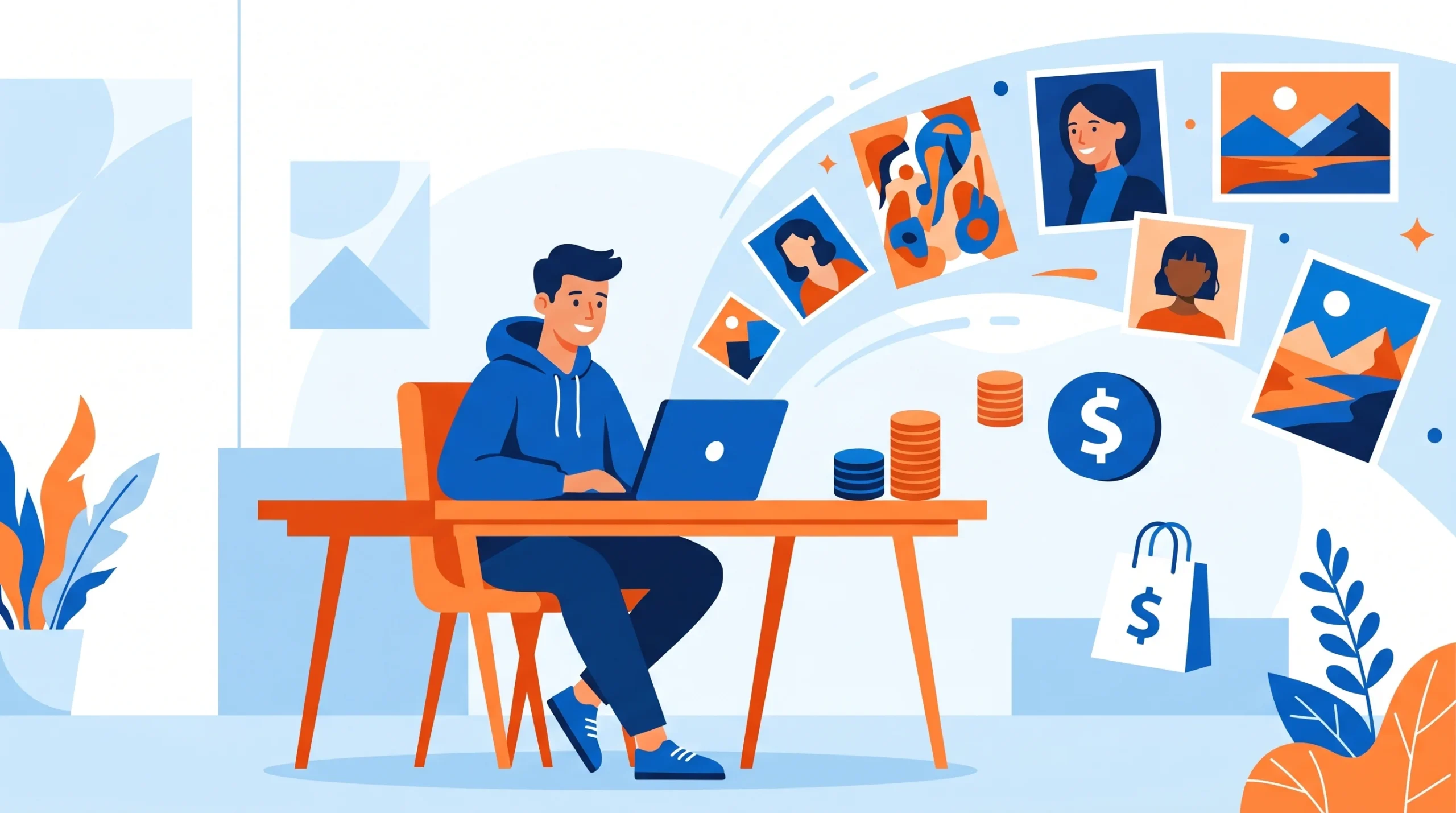
Let’s be honest about something most people are afraid to say out loud: you do not need to know how to draw, paint, or design to make real money from art in 2026. That statement would have sounded ridiculous five years ago. Today, it is simply true.
In fact, you can now make money with AI art without any skills, something that would have seemed impossible not long ago.
AI image generation has rewritten the rules entirely. The tools available right now, many of them free or almost free, allow anyone with a basic idea and some creative direction to produce stunning, professional-quality artwork in minutes. The question is no longer “can I create art?” because the answer is always yes. The real question is: what do you do with it once you have it?
This guide answers that question in full. Whether you are looking for a genuine side income, a creative outlet that pays, or a scalable online business, every method covered here is practical, accessible, and working for real people right now.
If you found your way here after reading about the best free AI tools for students, or from our guide on AI tools for freelancing on Fiverr and Upwork, you already know that AI has opened serious income opportunities across multiple skill levels. AI art is one of the most accessible of all of them.
What This Guide Covers:
- Best free and affordable AI art tools to start with
- How to make money with AI art through print-on-demand
- Selling AI art on Etsy, Redbubble, and digital marketplaces
- Offering AI art services on freelancing platforms
- Selling AI prompt packs as a low-overhead product
- Legal and copyright considerations before you start
- Common mistakes that cost beginners real money
Why Making Money with AI Art Without Skills Is Genuinely Possible in 2026
The Skill Has Shifted, Not Disappeared
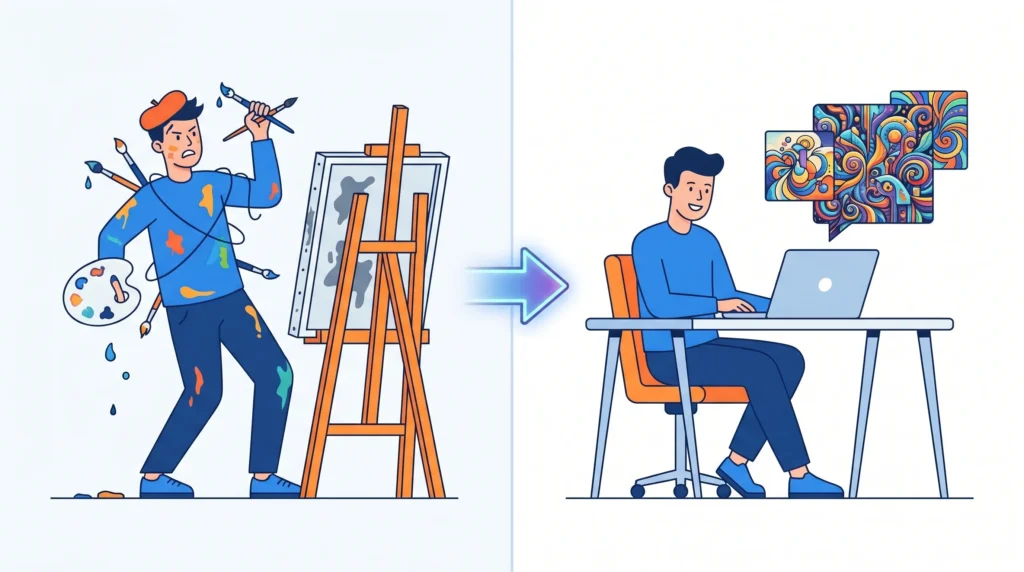
Before diving into methods, it is worth understanding something important: the skill required has not disappeared; it has simply changed. Traditional art required years of technical practice: brush control, anatomy, perspective, color theory, and so on. AI art requires a different kind of skill entirely: creative direction, prompt writing, niche selection, and an eye for what buyers actually want.
Anyone can develop these abilities in a matter of weeks. You do not need a course; you need curiosity, experimentation, and a willingness to learn by doing.
The other thing working in your favor is demand. Buyers across Etsy, Redbubble, Society6, and Gumroad are actively purchasing AI-generated artwork right now: wall art, digital downloads, merchandise designs, book covers, social media templates, and more. The market is real, it is growing, and most of the sellers currently serving it are not professional designers.
The Best Free AI Art Tools to Start Generating Income Today
Make Money with AI Art Without Any Skills: Start with the Right Tool
Before you can sell anything, you need to create it. The good news is that the best AI art tools are either completely free or offer generous free tiers that are more than enough to get started.
Midjourney remains the benchmark for AI image quality in 2026. Its outputs consistently produce the kind of visually striking, artistically credible results that buyers are willing to pay for. The interface runs through Discord, which feels unusual at first but becomes second nature quickly. Paid plans start affordably, and the quality jump over free tools is significant enough to justify it once you are generating income.
- Best for: wall art, book covers, concept art, fantasy illustrations, portrait commissions
- Output quality: industry-leading
- Learning curve: low to moderate; prompt skill develops fast
Adobe Firefly is completely free and runs in the browser with no installation required. More importantly for anyone planning to sell their work commercially, Firefly is trained on licensed content, which means its outputs are cleared for commercial use without the copyright ambiguity that surrounds some other tools.
- Best for: product mockups, social media graphics, printable designs, marketing visuals
- Output quality: excellent, especially for clean commercial-style work
- Commercial use: explicitly cleared
Leonardo AI offers a generous free tier with daily credits that refresh automatically. Its fine-tuned models allow you to generate images in highly specific styles: anime, realism, fantasy, vintage, and more. This style control is particularly valuable when building a themed product line.
- Best for: themed digital product lines, character design, merchandise graphics
- Output quality: very high across multiple styles
- Free tier: genuinely useful for starting out
If Midjourney and Firefly produce the raw art, Canva AI is where you turn it into a finished, sellable product. Templates for posters, wall art prints, social media packs, and digital downloads are built in. The AI tools inside Canva let you remove backgrounds, expand images, and generate supporting graphics to complete a design package.
- Best for: packaging your AI art into professional, print-ready products
- Output quality: excellent for commercial product finishing
- Free tier: comprehensive for most use cases
How to Make Money with AI Art: Every Method That Actually Works
1. Print-on-Demand: The Lowest-Risk Way to Start
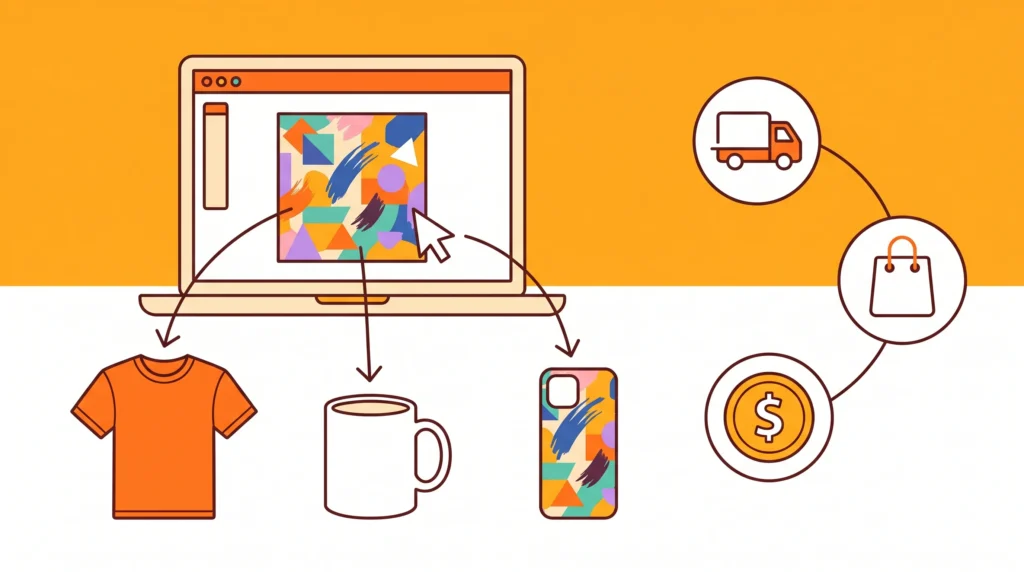
How the Print-on-Demand Model Works for AI Artists
Print-on-demand is the method most beginners should start with, and for good reason. You create a design, upload it to a platform, and the platform handles everything else: printing, fulfillment, shipping, and customer service. You collect a royalty on every sale without touching inventory, managing orders, or investing any upfront capital.
The platforms worth knowing:
- Redbubble: One of the most accessible; upload a design and it automatically appears across dozens of products, from t-shirts and hoodies to phone cases, mugs, and stickers.
- Merch by Amazon: Higher earning potential per sale, but requires an application and approval process. Worth pursuing once you have a proven design library.
- Society6: Skews toward the home decor buyer; wall prints, cushions, and art prints perform well here.
- Printful + Etsy: Printful integrates directly with your Etsy shop, handling production and shipping automatically while you manage the storefront and marketing.
What sells well on print-on-demand:
- Minimalist quote posters with aesthetic backgrounds
- Nature-inspired patterns: botanicals, watercolor florals, abstract landscapes
- Niche hobby designs: hiking, coffee, cats, dogs, yoga, gaming
- Seasonal and holiday-themed artwork
- Motivational and affirmation-based designs
The key to standing out: niche down aggressively. Thousands of shops sell “floral wall art”; far fewer sell “vintage botanical prints for a mid-century modern kitchen.” The narrower your niche, the less competition and the more targeted your buyer.
2. Selling Digital Downloads on Etsy: Passive Income at Scale
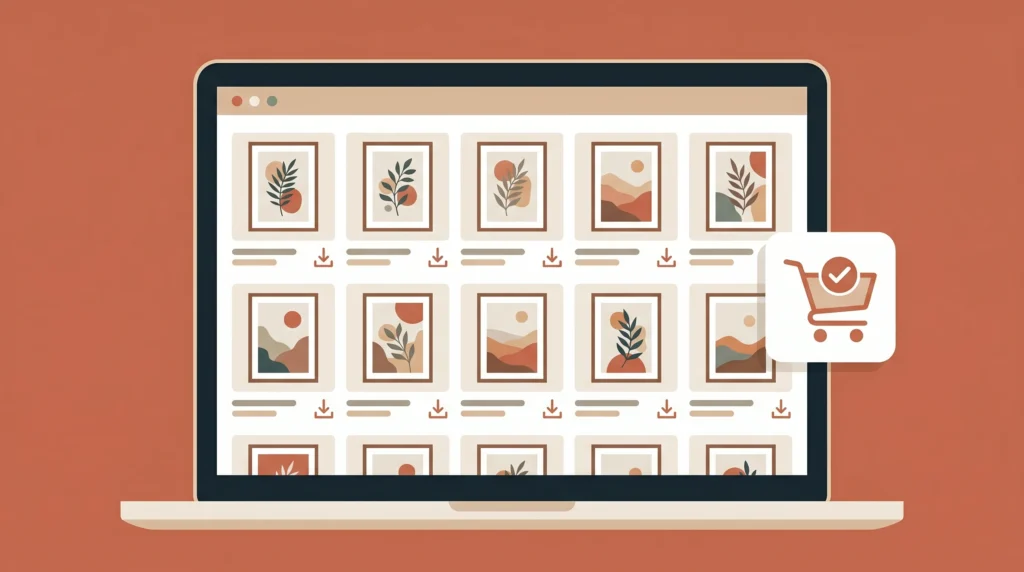
Why Etsy Is Still One of the Best Platforms for AI Art in 2026
Etsy has fully embraced digital products, and AI-generated art is among the most popular categories of digital downloads on the platform. The model is beautifully simple: create a design, list it as a downloadable file, and collect payment every time someone buys, with zero additional work on your end. One design can sell hundreds of times.
What digital art products work on Etsy:
- Printable wall art sets, including multiple coordinating pieces, sold as a bundle
- Digital planners and journal pages with aesthetic AI-generated backgrounds
- Clipart sets for educators, bloggers, and small business owners
- AI-generated coloring pages for children and adults
- Digital paper and pattern sets for crafters
- Tarot and oracle card illustrations
Pricing and bundling strategy:
Single prints typically sell for $2 to $5. Bundles of five to ten coordinated pieces sell for $8 to $20. The platform’s search algorithm rewards listings with strong keywords, detailed descriptions, and consistent sales history, so writing your listing copy carefully matters as much as the design itself. Use ChatGPT to draft keyword-rich Etsy titles and descriptions once you have your designs ready.
Etsy listing tips that most sellers miss:
- Use all 13 available tags and fill each one with a specific search phrase, not just single words
- Upload your highest-quality image as the primary photo; Etsy’s algorithm rewards high click-through rates
- Price competitively at first to build reviews, then raise prices gradually as social proof accumulates
- Bundle related designs together to increase average order value
3. Offering AI Art Services on Freelancing Platforms

Make Money with AI Art Without Any Skills by Selling Custom Creations
Platforms like Fiverr and Upwork have seen a significant rise in demand for AI-generated artwork as a custom service. Buyers who need unique visuals for their businesses, books, social media, or personal projects do not always want to learn the tools themselves; they would rather pay someone who already knows how to get results.
Services that sell consistently:
- Custom AI portraits and character illustrations
- AI-generated book covers for self-publishing authors
- YouTube thumbnail designs using AI-generated backgrounds
- Custom social media graphics and branding visuals
- AI-generated children’s book illustrations
- Fantasy and concept art for game developers and writers
Pricing guide for beginners:
Starting prices of $15 to $40 per piece are realistic for entry-level gigs. As your portfolio grows and your reviews accumulate, $75 to $150 per project is achievable for more complex commissions. The key to building a Fiverr or Upwork income from AI art is specialization: a gig titled “I will create AI-generated children’s book illustrations in watercolor style” will consistently outperform a generic “I will create AI art” listing because it targets a specific buyer with a specific need.
Refer back to the earlier guide on AI tools for freelancing on Fiverr and Upwork for a complete breakdown of how to write proposals and optimize gig descriptions that attract the right clients.
4. Selling AI Prompt Packs: A Surprisingly Profitable Low-Overhead Product
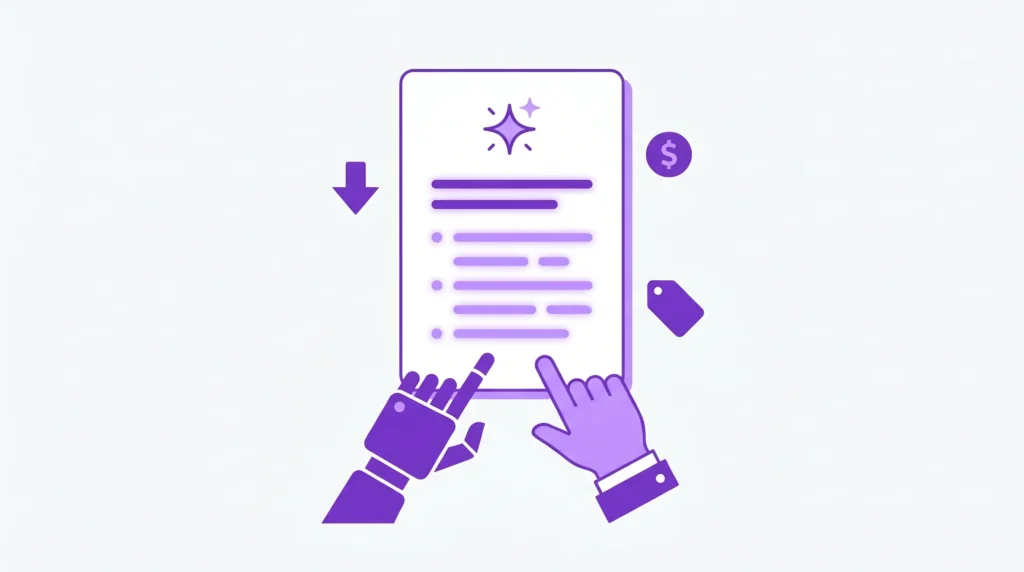
How to Monetize Your Prompt-Writing Skill
Once you spend time generating AI art, you naturally develop a library of prompts that reliably produce high-quality results. These prompts are a product in their own right, and a growing community of buyers, ranging from bloggers and small business owners to other aspiring AI artists, is willing to pay for prompt collections that save them the trial-and-error process.
Where to sell prompt packs:
- Gumroad: The most popular platform for digital creator products; straightforward setup with low fees
- Etsy: Prompt packs listed as digital downloads sell particularly well here
- Your own website: Higher margins, full brand control, and no platform dependency
- Patreon: Monthly subscription model for ongoing prompt releases, which creates recurring income
What makes a prompt pack worth buying:
- A specific, focused niche: “50 Midjourney Prompts for Minimalist Wall Art” is far more compelling than “100 AI Art Prompts.”
- Tested results with example images showing exactly what each prompt produces
- Organized clearly with categories and use case notes
- Priced between $5 and $25, depending on length, niche, and quality of included examples
5. Licensing AI Art to Businesses and Stock Platforms
Turning Single Designs into Ongoing Royalty Income
Businesses, marketers, bloggers, and publishers need visual content constantly. Licensing your AI art through stock platforms or directly to clients creates a model where your designs continue earning long after you created them.
Stock platforms to consider:
- Adobe Stock: Allows AI-generated images with disclosure; large buyer base and competitive royalties
- Shutterstock: Accepts AI art with proper labeling; one of the highest-traffic stock platforms available
- Creative Fabrica: Particularly strong for craft-oriented AI designs, fonts, and pattern files
Direct licensing:
Businesses will often pay significantly more for exclusive or semi-exclusive use of a design than stock royalties generate. Building a portfolio website, even a simple one, through a free platform like Carrd or Wix, allows you to pitch directly to small businesses, content creators, and marketing agencies who need custom imagery without the budget for a traditional designer.
Legal Considerations: What You Must Know Before Selling AI Art
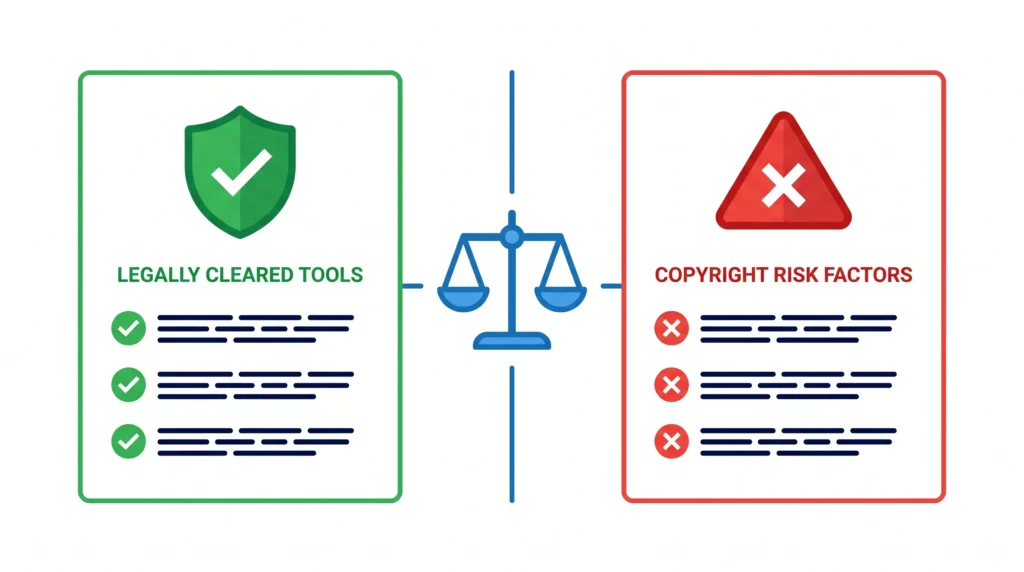
This section is not optional. Selling AI art without understanding the legal landscape creates real financial and reputational risk. Here is what every beginner needs to know:
Commercial use rights vary by tool:
- Midjourney’s paid plans grant commercial use rights; the free tier does not
- Adobe Firefly outputs are explicitly licensed for commercial use
- DALL-E 3 outputs grant commercial use rights to the user
- Always read the terms of service for any tool you plan to use commercially
Copyright and originality:
AI-generated images currently occupy a complex legal space in most jurisdictions. The general principle is that outputs need to be meaningfully transformed or curated by a human creator to have the strongest copyright claim. Generating thousands of identical outputs and listing them without curation is both legally weaker and commercially less effective than building a thoughtfully selected, niche-specific product line.
Platform-specific rules:
Etsy, Redbubble, and similar platforms have their own policies on AI art disclosure. Most require sellers to label AI-generated products accurately. Misrepresenting AI art as hand-drawn work is both unethical and a terms of service violation that can result in permanent account suspension.
Common Mistakes That Cost AI Art Sellers Real Money
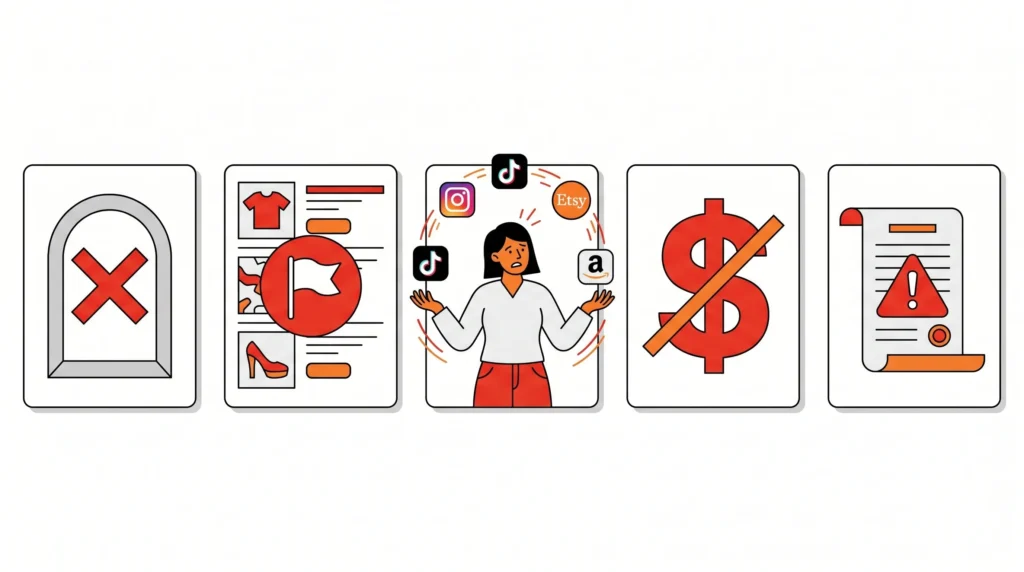
Starting without a niche: Generic AI art generates generic results in the marketplace. Pick a specific audience, a specific aesthetic, and a specific product type before you start generating.
Ignoring listing quality: Beautiful art buried under a poorly written listing title will not sell. Your keywords, description, and photos matter as much as the design itself.
Trying every method at once: Print-on-demand, Etsy downloads, freelancing, and licensing are all viable, but spreading across all four simultaneously means mastering none of them. Pick one, learn it properly, and build from there.
Skipping the commercial use check: Selling outputs from a tool that does not allow commercial use is a legal exposure you do not need. Use tools with clear commercial licensing from day one.
Pricing too low indefinitely: Starting with lower prices to build reviews is sensible; staying there permanently undervalues your work and attracts buyers who will be difficult clients. Raise prices as your reviews and portfolio grow.
Frequently Asked Questions
Q. Is it legal to sell AI-generated art?
Yes, in most cases, provided the AI tool you use grants commercial use rights, the artwork does not infringe on existing copyrights or trademarks, and you comply with the platform policies of wherever you sell. Adobe Firefly, DALL-E 3 via ChatGPT, and Midjourney paid plans all offer commercial use rights. Always verify the current terms of service for any tool you use.
Q. How much can you realistically earn from AI art without prior experience?
Earnings vary significantly based on niche selection, product quality, and consistency. Beginners who choose a focused niche, create a catalog of at least 20 to 30 products, and invest time in listing optimization often see their first sales within 30 to 60 days on Etsy or Redbubble. Monthly earnings of $200 to $800 are realistic within six months for consistent sellers; scaling beyond that typically requires expanding to multiple platforms or adding services to the product mix.
Q. Do I need to disclose that my art is AI-generated?
On most major selling platforms, yes. Etsy, Redbubble, and Adobe Stock all require AI art to be accurately labeled. Beyond platform requirements, transparency is a good practice: buyers who discover undisclosed AI use often leave negative reviews that disproportionately damage new sellers. Being upfront about your process while emphasizing the quality and uniqueness of your work is a better long-term strategy.
Q. What is the best AI art tool for someone with no experience at all?
For absolute beginners, Adobe Firefly is the most accessible starting point: free, browser-based, commercially licensed, and producing consistently good results without a steep learning curve. Once you are comfortable with the basics of prompt writing and style direction, Midjourney’s quality ceiling is significantly higher and worth the move.
Q. Can you build a full-time income from AI art?
People are doing it. The path typically involves combining multiple income streams: print-on-demand for passive income, Etsy digital downloads for scale, and freelance services for higher per-project earnings. Building any of these to full-time income levels takes consistent effort over six to twelve months; it is not a get-rich-quick model. It is, however, a genuinely viable creative business for anyone willing to treat it as one.

Final Thoughts
The barrier between having a creative idea and bringing it to life has essentially collapsed. The tools exist, they are accessible, and the market for what they can produce is real and growing.
What has not changed is the need for consistency, judgment, and strategic thinking. AI generates the image; you decide what to create, who to sell it to, how to present it, and how to build something that lasts beyond a single sale. That combination, accessible tools plus thoughtful human direction, is exactly where the opportunity sits in 2026.
Start with one tool, one product type, and one platform. Learn it properly before expanding. The AI art income stories you read about are built exactly that way: one focused decision at a time.