
How to Become an AI Red Teamer: If you had asked most people in 2023 how to get into artificial intelligence without writing code, the honest answer was: you probably can’t. That’s no longer true. One of the fastest-growing corners of the AI industry right now doesn’t ask for a computer science degree, a GitHub portfolio full of machine learning projects, or years of cybersecurity experience. It asks for something much rarer: people who are genuinely good at breaking things, spotting patterns, and thinking like a troublemaker with a purpose.
That role is AI red teaming, and in 2026 it has quietly become one of the best-paying, lowest-barrier entry points into the AI economy. If you’ve read our guide on How to Become a Prompt Engineer in 2026 — No Degree, No Experience, this is the natural next chapter: a role that rewards the same instinct for probing how AI models respond, except the goal isn’t to get better outputs. It’s to find where the model fails before someone else does, at scale, and often before the public ever sees the release.
This guide walks through exactly what AI red teamers do, why the hiring boom is happening right now, whether you actually need a technical background, and the realistic steps to land paid work even if you’ve never touched a security tool in your life.
What Does an AI Red Teamer Actually Do? (Explained for Complete Beginners)

An AI red teamer is someone who deliberately tries to make an AI system behave badly, so the people building it can fix the problem before it reaches real users. That’s the short answer. The longer answer is more interesting.
Red teaming didn’t start in AI. The term comes from military and cybersecurity exercises, where a “red team” plays the attacker against a “blue team” defending a system. When applied to AI, the target isn’t a network or a building; it’s a language model, an image generator, or an AI agent. A red teamer’s job is to push that system toward outputs it isn’t supposed to produce: harmful instructions, biased or discriminatory responses, leaked private data, unsafe advice, or behavior that breaks the rules the AI lab set for it.
Day to day, this can look like:
- Writing creative prompts designed to trick a chatbot into ignoring its safety instructions
- Testing whether an AI agent can be manipulated into taking an unintended action, like sending money or deleting files
- Checking whether a model gives different quality answers based on someone’s name, accent, or background
- Documenting exactly how and why a failure happened, so engineers can reproduce and fix it
Notice what’s missing from that list: you don’t need to write a single line of Python to do most of it. The core skill is adversarial thinking, not software engineering.
Why Regulators and AI Labs Are Suddenly Hiring for This Role in 2026?

In short: AI companies now have to prove their models are safe before release, not just claim it. That single shift is driving most of the current hiring.
Through 2025 and into 2026, governments and industry bodies moved from encouraging voluntary safety testing to expecting documented evidence of it. AI labs releasing new models are increasingly asked to show they stress-tested the system against misuse, bias, and manipulation before shipping it. Internal teams alone can’t cover that volume of testing, especially across every language, cultural context, and edge case a global product touches. That’s created sustained demand for external and contract red teamers who bring outside perspectives the internal team might miss entirely.
There’s a second driver too: AI agents. As more products let AI systems take real actions, like booking appointments, sending emails, or executing code, the cost of a safety failure has gone up. A chatbot giving a bad answer is embarrassing. An AI agent taking a wrong real-world action is a liability problem. That has pushed red teaming from a nice-to-have into a standard part of how serious AI products get built and audited.
If you’ve read our article on New AI Jobs Created in 2026 — How to Get Hired With Zero Experience, you’ll recognize the pattern: entire categories of AI-native work are appearing that simply didn’t exist a few years ago, and hiring managers are more interested in demonstrated skill than formal credentials.
AI Red Teamer vs AI Safety Evaluator vs AI QA Tester: What’s the Difference
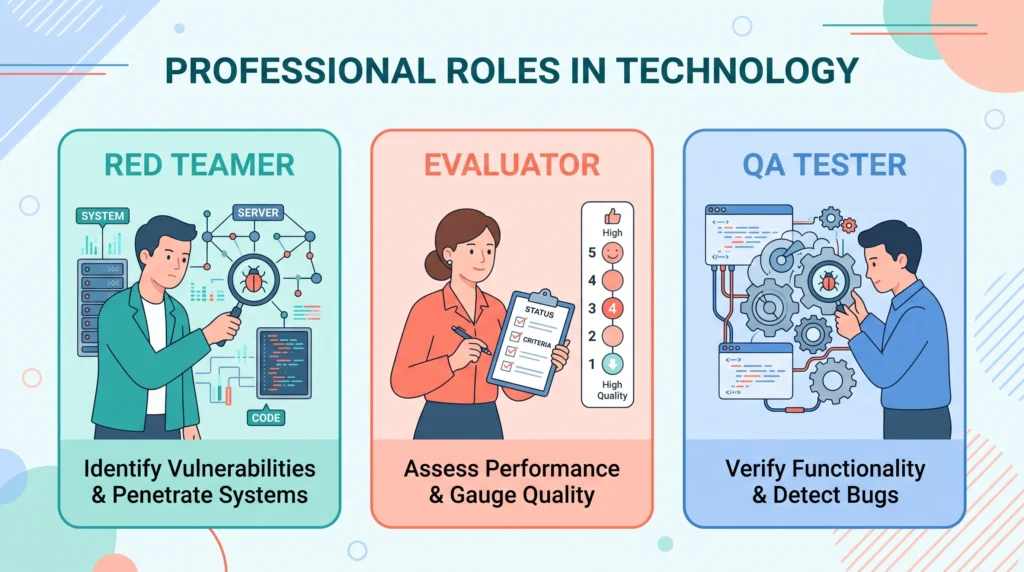
These three titles get used almost interchangeably in job postings, which confuses a lot of beginners. Here’s a simple breakdown.
| Role | Main Focus | Mindset |
|---|---|---|
| AI Red Teamer | Actively tries to break the model or bypass its safety rules | Adversarial: “How can I make this fail?” |
| AI Safety Evaluator | Assesses model outputs against defined safety and quality criteria | Analytical: “Does this meet the standard?” |
| AI QA Tester | Checks general functionality, accuracy, and reliability | Systematic: “Does this work as intended?” |
In practice, many contractors do a blend of all three, especially early in their career. A single testing project might ask you to attempt jailbreaks (red teaming), rate whether a response crosses a safety line (evaluation), and log clear, reproducible bug reports (QA). Don’t get too hung up on which exact title to chase; focus on building the underlying skill, and the titles will sort themselves out once you have a track record.
Do You Need a Coding or Cybersecurity Background? The Honest Answer
No, not for entry-level and mid-level AI red teaming work. What you do need is strong written communication, methodical thinking, and genuine curiosity about how these systems break.
This surprises people, so it’s worth being precise about it. Traditional penetration testing, the kind aimed at networks and software, absolutely requires technical depth: understanding code, exploits, and system architecture. AI red teaming borrows the name and the adversarial spirit, but a large share of the work targets natural language, reasoning, and behavior rather than code vulnerabilities. That means people with backgrounds in writing, psychology, linguistics, teaching, journalism, or even debate and law have a real edge, because those backgrounds train the exact skill this work rewards: understanding how language can be twisted, reframed, or exploited to produce an unintended result.
That said, a light technical foundation does help you move up faster. Being comfortable with basic terminology (what a “prompt injection” is, what “jailbreaking” means, how an AI agent differs from a chatbot) and being willing to learn simple tools will open more opportunities than staying purely non-technical. You don’t need to become an engineer. You need to become fluent in the vocabulary of the field.
Step 1: Learn the Core Skill — Finding Where AI Models Fail

Before you apply anywhere, you need hands-on reps at actually doing this. The good news: you can start today, for free, using publicly available AI chatbots.
Spend time deliberately trying to get a model to:
- Contradict its own stated rules or guidelines
- Give advice it should decline to give
- Produce biased or inconsistent answers when you change small details like a name or location
- Reveal information about how it was instructed to behave
The goal isn’t to cause harm or publish jailbreaks; it’s to build your own internal library of techniques and, more importantly, your ability to explain clearly why a particular approach worked. Keep a simple log: the prompt you used, the response you got, and a short note on what safety principle it violated and why. This log becomes the foundation of your portfolio in the next step.
This is also where methodical thinking separates hobbyists from hireable candidates. Anyone can send one clever prompt and get lucky. What labs and clients pay for is someone who can systematically test a hypothesis (for example, “this model handles ambiguous medical questions inconsistently”) across dozens of variations and document the pattern, not just a single lucky hit.
Step 2: Build a Portfolio With Free Tools
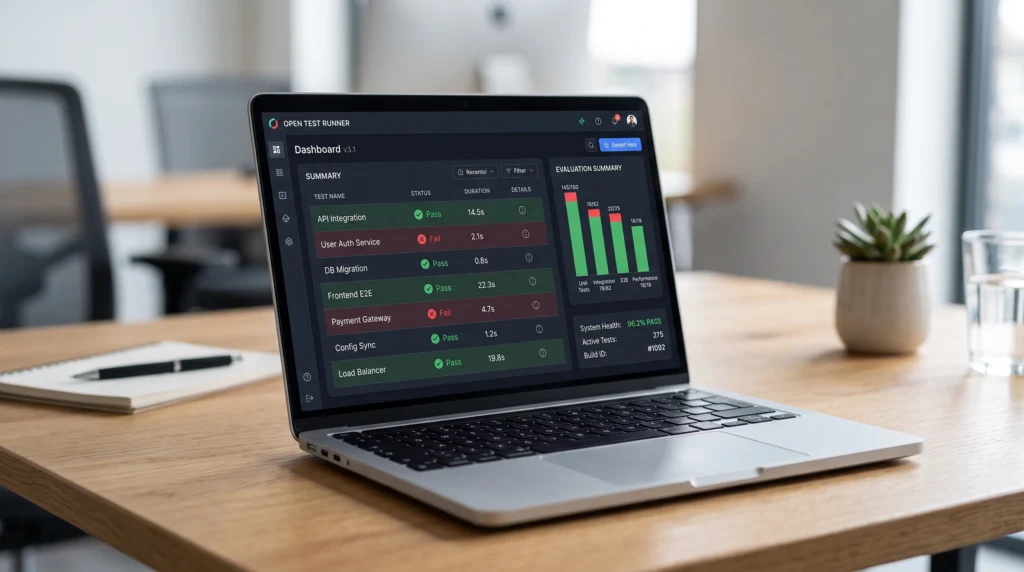
You don’t need to wait for a job offer to start building credibility. A handful of free and open tools let you practice structured AI testing and show, not just tell, that you understand the discipline.
Promptfoo is a popular open-source tool for systematically testing prompts and model outputs against defined criteria, which is useful for practicing the “evaluation” side of the work and learning how professional testing gets structured rather than done ad hoc.
Giskard is an open-source testing framework built specifically for catching bias, robustness issues, and safety problems in AI models, and it’s a good way to get comfortable with the kind of structured vulnerability categories that real red-teaming engagements use.
Garak, an open-source LLM vulnerability scanner, is worth exploring once you’re ready to go slightly deeper; it automates many common probing techniques and can show you, by example, the categories of failure that professionals systematically check for.
You don’t need to master any of these tools at an expert level. Running a handful of tests, understanding the output, and being able to explain what a “vulnerability category” means in plain English is enough to set you apart from someone who has only ever manually typed prompts into a chat window.
Turn this practice into a simple portfolio: a short document or webpage listing three to five model behaviors you found, how you found them, why they matter from a safety standpoint, and how you’d recommend fixing or mitigating them. This single artifact does more for your credibility than any resume bullet point.
Step 3: Where to Find Your First Contract?
Your first paid gig is unlikely to come from a huge AI lab directly. It’s far more likely to come from one of three sources: specialized red-teaming platforms, boutique AI safety and security firms, or general freelance marketplaces where AI companies post short-term evaluation contracts.
A growing number of platforms exist specifically to connect AI companies with distributed pools of testers and evaluators for red-teaming and data-quality work; these are usually the fastest on-ramp for beginners because the screening process is built around demonstrated skill rather than formal credentials. Boutique AI security and evaluation consultancies are another strong option, since they often take on less experienced testers and pair them with more senior red teamers on real engagements. Finally, don’t overlook general freelance platforms and remote job boards, where AI companies increasingly post short-term contracts specifically labeled as red-teaming, safety evaluation, or AI QA work.
When you apply, lead with your portfolio, not your resume. A hiring manager scanning dozens of applications will remember the candidate who attached three concrete examples of model failures they found and explained clearly, far more than one who listed generic soft skills.
Realistic Pay Ranges by Experience Level

Pay in this field varies widely depending on the client, the complexity of the model being tested, and how specialized your testing focus is. As a general guide:
| Experience Level | Typical Range | What It Usually Involves |
|---|---|---|
| Entry-Level Contractor | Roughly $20–$45/hr | Prompt-based testing, structured evaluation tasks, general bias and safety checks |
| Specialist Contractor | Roughly $45–$100/hr | Domain-specific testing (legal, medical, coding), agent behavior testing, more complex jailbreak research |
| Senior / Full-Time Specialist | Often into six figures annually | Leading red-team engagements, designing test methodologies, reporting directly to safety teams |
Treat these as general reference points rather than guarantees; actual rates depend heavily on the client, the region, and how specialized your niche becomes. Entry-level work is genuinely accessible without a technical background, but the biggest pay jumps tend to go to people who develop a specific area of depth, whether that’s testing AI agents, testing models in a particular language or cultural context, or testing a specific industry vertical like healthcare or finance.
Career Path: From First Gig to Full-Time AI Safety Specialist

Most people don’t walk into a full-time AI safety role on day one, and that’s fine. The realistic path looks more like this: start with short, structured contract testing tasks through a platform or boutique firm; build a track record of well-documented findings; specialize in one or two testing categories where you consistently perform well; and use that specialization to move toward longer contracts, direct relationships with AI labs, or eventually a full-time safety or evaluation role.
If you’re coming from a writing, research, or teaching background, consider pairing this path with something like our guide How to Use AI to Get Hired Faster: Resume, Cover Letter and Interview Tools That Actually Work (2026), since translating a non-technical background into language that resonates with AI-industry hiring managers is its own skill worth practicing. And if you’re weighing this against other emerging AI career paths, Which Jobs Are Safe From AI in 2026 — And How to Earn More With Them is a useful companion read for thinking through where roles like this one fit into the broader shift happening across the job market.
Common Mistakes That Get Beginner Applications Rejected
A few patterns show up repeatedly among beginners who struggle to break in:
Submitting generic examples instead of specific ones. “I tried to jailbreak ChatGPT” tells a hiring manager nothing. A precise prompt, the exact response, and a clear explanation of the safety issue tell them everything.
Treating this as a game rather than a documentation exercise. Finding a clever failure is only half the job; explaining it clearly, consistently, and professionally is the other half, and it’s the half that actually gets paid.
Ignoring the ethics of the work. AI companies want testers who understand the difference between responsible probing meant to improve safety and genuinely harmful content creation. Applications that lean too hard into shock value rather than constructive analysis raise red flags rather than earning trust.
Assuming you need permission to start. Many beginners wait for a job posting before practicing. The candidates who move fastest are the ones who already have a small portfolio built before they ever apply.
Common Mistakes at a Glance
- Vague, unspecific examples instead of documented test cases
- No clear explanation of why a failure matters from a safety standpoint
- Overly aggressive or shock-value testing without a constructive framing
- Waiting for a job posting instead of practicing and building proof of skill first
Conclusion
AI red teaming sits in a genuinely rare category right now: high demand, rising pay, and a low barrier to entry, all at the same time. That combination doesn’t last forever in any industry, and it’s already starting to attract more competition as awareness of the field grows. The people who get in now, with a documented portfolio and a methodical approach to finding and explaining AI failures, are positioned to grow alongside the field rather than competing to catch up later. You don’t need a computer science degree or a cybersecurity certification to start. You need curiosity, discipline, and the willingness to practice the skill before anyone pays you for it.
Frequently Asked Questions
Q. Can I become an AI red teamer without a computer science degree?
Yes. Most entry-level and mid-level AI red-teaming work values written communication, methodical thinking, and creative problem-solving over formal technical credentials. A degree can help for specialized or senior roles, but it isn’t required to start.
Q. How much do beginner AI red teamers get paid per hour?
Entry-level contract work typically falls in the roughly $20–$45 per hour range, depending on the platform, client, and complexity of the testing task. Rates rise significantly as you specialize.
Q. What’s the difference between AI red teaming and traditional penetration testing?
Traditional penetration testing targets software and network vulnerabilities and usually requires great technical skill. AI red teaming targets model behavior and language, focusing on how a model can be manipulated into unsafe or unintended outputs, which makes it accessible to people without a coding background.
Q. Which companies hire AI red teamers and safety evaluators?
AI labs, specialized AI safety and security consultancies, and dedicated red-teaming and evaluation platforms all hire for this work, often through contract arrangements rather than traditional full-time roles, especially at the entry level.
Q. Is AI red teaming a stable long-term career or a short-term trend?
It’s likely to remain a stable and growing field, since safety testing requirements are tied to regulatory expectations and AI labs’ own risk management needs, both of which are increasing rather than fading as AI systems become more capable and widely used.
Q. Do I need to know how to write code to start?
No, not for most entry-level testing work. Coding knowledge becomes more useful as you move into specialized or senior roles, but the core skill for beginners is adversarial thinking and clear documentation.
Q. What’s the fastest way to build a portfolio with no experience?
Practice testing publicly available AI chatbots, document your findings clearly with prompts, responses, and explanations of the safety issue, and try a free open-source testing tool like Promptfoo or Giskard to show you understand structured evaluation.
Q. Is AI red teaming the same as AI bias testing?
Bias testing is one specific category within the broader field of AI red teaming and safety evaluation. Many red teamers work across multiple categories, including bias, misuse, and manipulation testing, rather than focusing on just one.
Q. Can I do AI red teaming work part-time or remotely?
Yes, most AI red-teaming contract work is remote and project-based, which makes it well suited to part-time work or a side income stream alongside another job.
Q. What industries need AI red teamers the most right now?
Demand is highest wherever AI systems carry real consequences if they fail, including healthcare, finance, legal services, and any product involving AI agents that can take real-world actions.